Did you know that I don’t know what I am doing? It’s true. At least that’s how I feel sometimes when dealing with the SEO/SEM aspects of my job.
Many of my areas of operation are so beautifully stable and predictable, at least within reason. Working with programmers, we have a plan and a language to follow to achieve our goals. Life in the accounting department is fairly stable in its approaches. Administrative, Customer relations, human resource development? They all have some form of measurable reality.
Search engine optimization? Not a chance. We’re not even let into the kitchen to see what’s in the fridge, never mind given the recipe to cook a feast for our clients. It is a truly interesting and challenging aspect of Internet business development. It is tantamount to working in the dark or having business plans plucked from the pages of the grocery store rag. Heck, maybe Aliens can tell me the truth about the algorithms. Maybe even Macdonald’s ‘secret’ sauce while they’re at it.
Beware of the Great Beasts of Google!
This brings me to the greatest mythological creature to roam the Google landscape since ‘the sandbox’; The Google Toolbar Page Rank (TBPR) system. While the jury may still be out on the ‘sandbox’, I am here to slay the beast that is the TBPR, right here, right now. Forever let it rest in peace where it truly belongs, in Google purgatory. I am not saying it is without its relative value, it’s mere existence quantifies that. It just doesn’t have a ‘measurable’ value that warrants earmarking any serious marketing dollars. It is being overvalued in today’s SEO landscape. Don’t spend time and money trying to get a higher Page Rank. Just love it for what it is.
I have not taken this journey lightly. As a consequence of the ‘mystery’ surrounding the algorithms and the SEO community, I knew there would be those to lash out in a vain attempt to hold onto the LGB (little green bar) that is so much a part of their culture. He is a destructive beast though. Eating up great swaths of forum boards, causing countless hours of ‘webmaster worry’ and even deluding the minds of its followers. I am truly sorry, but it must end. This creature must die. We must move on to ‘greener’ pastures of content relevance, semantic indexing, organic link building and the other wonders that we have from the great Search Engine Gods.
What is this Page Rank Phenomenon?
PageRank is, in essence, a rough system for estimating the value of a given link based on the links that point to the host page. Since PageRank's inception in the late '90s, more subtle and sophisticated link analysis systems have taken the place of PageRank.
Thus, in the modern era of SEO, the PageRank measurement in Google's toolbar, directory, or through sites that query the service is of limited value. Pages with PR8 can be found ranked 20-30 positions below pages with a PR3 or PR4. Additionally, the toolbar numbers are updated only every 3-6 months, making the values even less useful. Rather than focusing on PageRank, it's important to think holistically about a link's worth. Have an organic approach to things.
What doesn’t seem to be commonly known is its ‘true’ and ‘measurable’ value in the marketing landscape. I have spent far too many hours of mind numbing technical document and conventional wisdom research that has lead me to my eventual perspective on the whole Page Rank and it’s ‘relevance’ (a little LSA humor there) as far as it relates to being part of a meaningful online marketing campaign.
The Value of Google’s Page Rank System
At the core of my interest is ‘value’. What is the value of the LGB? Is there one? If so, then how can it be defined and measured for ROI. I don’t look at SEO as a hobby nor a passing interest. It’s about business. It is a service that is part of a larger scheme of Internet business development. As such I have to quantify my action and investments (of time and money) spent on my activities, which is none too easy in the SEO world.
I have for too long watched and listened to a variety of hubbub about Page Rank (PR) and the Google toolbar phenomenon. I looked into, found little that warranted further research investment and we moved onto other aspects of SEM/SEO. Well, doesn’t that little beast just keeps growing, as does the myth. People’s beliefs and ideas surrounding the TBPR system it is truly incredible.
Listen to the Masters of Yore
I have had it argued, in all seriousness, that the TBPR had a value as consumers would consult it for ‘authority’ prior to making a purchase. Oh come on!
As penned by SE Guru Mike Grehan,
“Can you imagine some surfer finding the digital camera of his dreams at a knock-down bargain price but refusing to buy it because the page it's on only has a PR of one? I don't think so.”
Grehan did an interview in 2003 with Google engineer, Daniel Dulitz. When asked about data accuracy in the toolbar meter. He told Mike that there are two elements: accuracy and precision. The toolbar is accurate but not very precise. He added, "We have a lot more precision available to us than we represent in a 10-step scale."
When asked about the obsession to ‘the little green bar’ by the SEO community and webmasters, Dulitz said,
For search engine marketing, search engine optimization purposes, yeah, I'd say that there's too much emphasis placed on what that PR number actually is.... So, if people are trying to look at what we're doing and their idea is based on that single thing from 1 to 10, then... well, they're not going to be effective in figuring out what we're doing at all.”
In an interview with Lee Odden at the WebmasterWorld Pubcon in the spring of 2006;
Given the attention that people have given to PageRank, which is in Google’s toolbar, you can see how I’d feel about using toolbar data. I’m not going to say whether Google uses a particular signal in our ranking; I just wanted to communicate some of the potential problems in using things like toolbar data.”
Another chat between Matt and Lee produced “Google does not use toolbar data for rankings. He mentioned that it certainly didn't help that in the "Meet the Crawlers" session at SES NYC, the MSN rep suggested that MSN "might" be using user/toolbar info. That suggests the other search engines do as well. Matt also said that user data would be too easy to spam to use for rankings.”
Toolbar Page Rank is Dead! Long Live Targeted Traffic!
Is not the end-game of Internet marketing and SEO, getting more targeted traffic? From which, we hope to illicit the best possible conversion rates? Honestly, in my SEM/SEO background and training, Toolbar PR has not more than a passing metric for general consumption for quite some time. Those selling text link advertising would have you believe it is the all powerful measuring tool. Strange, I have seen PR0 Sites with better SERPs and traffic than PR6. Isn’t my advertising about the distribution channel?
Do I want my advertising on the site with a pretty green bar that read 6, or on the site that actually gets the traffic I am targeting? For some reason, SEO folks have a skewed marketing perspective and like things the other way around.
Just like so many websites disappearing into the Google sandbox, let this menace of Google PR terrorize SEO’s and Webmasters alike no longer. Let us rejoice and move onto new and wonderful lands with promises of getting traffic. Wonderful, life giving, targeted traffic. That’s truly what matters to the website. It’s the food that gives it life. I shall see you on the other side. Please leave this place or Page Rank hell now, before it’s too late.
Make your own conclusions;
Article Resources; Grehan ClickZ article; http://clickz.com/experts/search/results/article.php/3522286 Grehan interview ; http://www.e-marketing-news.co.uk/december_2003.html Lee and Matt II; http://www.toprankblog.com/2006/04/matt-cutts-on-toolbar-data/ Lee and Matt I; http://www.searchnewz.com/searchnewz-12-20060419YPNPartyBostonPubcon.html
Monday, July 24, 2006


Tuesday, July 04, 2006
Do Search Engines Care About Valid HTML?
Like most web developers, I've heard a lot about the importance of valid html recently. I've read about how it makes it easier for people with disabilities to access your site, how it's more stable for browsers, and how it will make your site easier to be indexed by the search engines.
So when I set out to design my most recent site, I made sure that I validated each and every page of the site. But then I got to thinking – while it may make my site easier to index, does that mean that it will improve my search engine rankings? How many of the top sites have valid html?
To get a feel for how much value the search engines place on being html validated, I decided to do a little experiment. I started by downloading the handy Firefox HTML Validator Extension (http://users.skynet.be/mgueury/mozilla/) that shows in the corner of the browser whether or not the current page you are on is valid html. It shows a green check when the page is valid, an exclamation point when there are warnings, and a red x when there are serious errors.
I decided to use Yahoo! Buzz Index to determine the top 5 most searched terms for the day, which happened to be "World Cup 2006", "WWE", "FIFA", "Shakira", and "Paris Hilton". I then searched each term in the big three search engines (Google, Yahoo!, and MSN) and checked the top 10 results for each with the validator. That gave me 150 of the most important data points on the web for that day.
The results were particularly shocking to me – only 7 of the 150 resulting pages had valid html (4.7%). 97 of the 150 had warnings (64.7%) while 46 of the 150 received the red x (30.7%). The results were pretty much independent of search engine or term. Google had only 4 out of 50 results validate (8%), MSN had 3 of 50 (6%), and Yahoo! had none. The term with the most valid results was "Paris Hilton" which turned up 3 of the 7 valid pages. Now I realize that this isn't a completely exhaustive study, but it at least shows that valid html doesn't seem to be much of a factor for the top searches on the top search engines.
Even more surprising was that none of the three search engines home pages validated! How important is valid html if Google, Yahoo!, and MSN don't even practice it themselves? It should be noted, however, that MSN's results page was valid html. Yahoo's homepage had 154 warnings, MSN's had 65, and Google's had 22. Google's search results page not only didn't validate, it had 6 errors!
In perusing the web I also noticed that immensely popular sites like ESPN.com, IMDB, and MySpace don't validate. So what is one to conclude from all of this?
It's reasonable to conclude that at this time valid html isn't going to help you improve your search position. If it has any impact on results, it is minimal compared to other factors. The other reasons to use valid html are strong and I would still recommend all developers begin validating their sites; just don't expect that doing it will catapult you up the search rankings right now.
About the Author: Adam McFarland owns iPrioritize - to-do lists that can be edited at any time from any place in the world. Email, print, check from your mobile phone, subscribe via RSS, and share with others.
ALSO SEE:
Validation Isn't Everything
Like it or not, industry jargon often coughs up terms that become buzzwords. When this occurs—and it occurs across the board; web development is no exception—the terms can become diluted, even ambiguous...
So when I set out to design my most recent site, I made sure that I validated each and every page of the site. But then I got to thinking – while it may make my site easier to index, does that mean that it will improve my search engine rankings? How many of the top sites have valid html?
To get a feel for how much value the search engines place on being html validated, I decided to do a little experiment. I started by downloading the handy Firefox HTML Validator Extension (http://users.skynet.be/mgueury/mozilla/) that shows in the corner of the browser whether or not the current page you are on is valid html. It shows a green check when the page is valid, an exclamation point when there are warnings, and a red x when there are serious errors.
I decided to use Yahoo! Buzz Index to determine the top 5 most searched terms for the day, which happened to be "World Cup 2006", "WWE", "FIFA", "Shakira", and "Paris Hilton". I then searched each term in the big three search engines (Google, Yahoo!, and MSN) and checked the top 10 results for each with the validator. That gave me 150 of the most important data points on the web for that day.
The results were particularly shocking to me – only 7 of the 150 resulting pages had valid html (4.7%). 97 of the 150 had warnings (64.7%) while 46 of the 150 received the red x (30.7%). The results were pretty much independent of search engine or term. Google had only 4 out of 50 results validate (8%), MSN had 3 of 50 (6%), and Yahoo! had none. The term with the most valid results was "Paris Hilton" which turned up 3 of the 7 valid pages. Now I realize that this isn't a completely exhaustive study, but it at least shows that valid html doesn't seem to be much of a factor for the top searches on the top search engines.
Even more surprising was that none of the three search engines home pages validated! How important is valid html if Google, Yahoo!, and MSN don't even practice it themselves? It should be noted, however, that MSN's results page was valid html. Yahoo's homepage had 154 warnings, MSN's had 65, and Google's had 22. Google's search results page not only didn't validate, it had 6 errors!
In perusing the web I also noticed that immensely popular sites like ESPN.com, IMDB, and MySpace don't validate. So what is one to conclude from all of this?
It's reasonable to conclude that at this time valid html isn't going to help you improve your search position. If it has any impact on results, it is minimal compared to other factors. The other reasons to use valid html are strong and I would still recommend all developers begin validating their sites; just don't expect that doing it will catapult you up the search rankings right now.
About the Author: Adam McFarland owns iPrioritize - to-do lists that can be edited at any time from any place in the world. Email, print, check from your mobile phone, subscribe via RSS, and share with others.
ALSO SEE:
Validation Isn't Everything
Like it or not, industry jargon often coughs up terms that become buzzwords. When this occurs—and it occurs across the board; web development is no exception—the terms can become diluted, even ambiguous...
Wednesday, June 28, 2006
Google goes to court to defend its ranking methods
By Juan Carlos Perez, IDG News Service
Google will try to convince a judge on Friday to dismiss a lawsuit that challenges the heart of the company’s business: its methods for indexing and ranking Web pages.
In March, Google was sued by KinderStart.com , which alleges it suffered crippling financial harm after its Web site got dropped from the search engine’s index.
The case reflects the enormous impact of search engines on the business world at large. It has become crucial for many businesses to rank well in search engine results. An entire industry has sprouted to serve this “search engine optimization” need.
As the world’s most popular search engine, Google wields the strongest influence. Having a Web site that ranks low or disappears altogether from the Google index can have devastating effects for a company. This is what KinderStart.com alleges happened to it.
“It’s a very important case for many reasons. Everyone uses search engines, so the question is: Are you seeing true and faithful results?” said Gregory Yu, KinderStart.com’s attorney.
“Google shouldn’t have completely free range to be able to remove sites or hit them with a zero PageRank,” he added, referring to the patented technology at the heart of Google’s algorithmic ranking.
KinderStart.com is charging Google, among other things, with violating its right to free speech; illegally using a monopoly position to harm competitors; engaging in unfair practices and competition; committing defamation and libel; and violating the Federal Communications Act.
The Web publisher seeks a class action certification for the lawsuit, damages and injunctive relief, among other things.
In motions filed in May, Google argues that Judge Jeremy Fogel, of the U.S. District Court for the Northern District of California, San Jose Division, should dismiss the lawsuit, saying that the case boils down to one essential question: Should search engines or should courts determine Web sites’ relevancy? “If KinderStart were right … neither Google nor any other search engine could operate, as it would constantly face lawsuits from businesses seeking more favorable positioning,” Google’s motion reads.
Google also asks the judge to strike three of the suit’s counts, alleging they violate Google’s exercise of free speech in connection with a public issue. This is prohibited under a California law called the Anti-SLAPP statute, Google argues.
KinderStart.com , based in Norwalk, Calif., began publishing a Web site for parents of children under 7 years old in May 2000 and in 2003 the site joined Google’s AdSense ad network, according to the complaint. Yet, starting in March and April 2005, the Web site suffered a “cataclysmic” fall in traffic of about 70 percent and a drop in AdSense revenue of about 80 percent, from which it hasn’t recovered, and which the company blames on its removal from the Google index.
KinderStart.com claims it has never been notified by phone, mail or in person of the reason for its Web site’s exclusion. Google states in its Web site that it reserves the right to remove Web sites from its index for various reasons. KinderStart.com states it hasn’t knowingly violated any of Google’s webmaster guidelines.
In February, Google decided to remove the German Web site of car maker BMW for allegedly trying to deceive its search robot to gain higher placement. Days later Google reincorporated the site to its index, saying BMW had undone the offending changes, although BMW never admitted any wrongdoing.
Google will try to convince a judge on Friday to dismiss a lawsuit that challenges the heart of the company’s business: its methods for indexing and ranking Web pages.
In March, Google was sued by KinderStart.com , which alleges it suffered crippling financial harm after its Web site got dropped from the search engine’s index.
The case reflects the enormous impact of search engines on the business world at large. It has become crucial for many businesses to rank well in search engine results. An entire industry has sprouted to serve this “search engine optimization” need.
As the world’s most popular search engine, Google wields the strongest influence. Having a Web site that ranks low or disappears altogether from the Google index can have devastating effects for a company. This is what KinderStart.com alleges happened to it.
“It’s a very important case for many reasons. Everyone uses search engines, so the question is: Are you seeing true and faithful results?” said Gregory Yu, KinderStart.com’s attorney.
“Google shouldn’t have completely free range to be able to remove sites or hit them with a zero PageRank,” he added, referring to the patented technology at the heart of Google’s algorithmic ranking.
KinderStart.com is charging Google, among other things, with violating its right to free speech; illegally using a monopoly position to harm competitors; engaging in unfair practices and competition; committing defamation and libel; and violating the Federal Communications Act.
The Web publisher seeks a class action certification for the lawsuit, damages and injunctive relief, among other things.
In motions filed in May, Google argues that Judge Jeremy Fogel, of the U.S. District Court for the Northern District of California, San Jose Division, should dismiss the lawsuit, saying that the case boils down to one essential question: Should search engines or should courts determine Web sites’ relevancy? “If KinderStart were right … neither Google nor any other search engine could operate, as it would constantly face lawsuits from businesses seeking more favorable positioning,” Google’s motion reads.
Google also asks the judge to strike three of the suit’s counts, alleging they violate Google’s exercise of free speech in connection with a public issue. This is prohibited under a California law called the Anti-SLAPP statute, Google argues.
KinderStart.com , based in Norwalk, Calif., began publishing a Web site for parents of children under 7 years old in May 2000 and in 2003 the site joined Google’s AdSense ad network, according to the complaint. Yet, starting in March and April 2005, the Web site suffered a “cataclysmic” fall in traffic of about 70 percent and a drop in AdSense revenue of about 80 percent, from which it hasn’t recovered, and which the company blames on its removal from the Google index.
KinderStart.com claims it has never been notified by phone, mail or in person of the reason for its Web site’s exclusion. Google states in its Web site that it reserves the right to remove Web sites from its index for various reasons. KinderStart.com states it hasn’t knowingly violated any of Google’s webmaster guidelines.
In February, Google decided to remove the German Web site of car maker BMW for allegedly trying to deceive its search robot to gain higher placement. Days later Google reincorporated the site to its index, saying BMW had undone the offending changes, although BMW never admitted any wrongdoing.
Saturday, June 17, 2006
Google on secret mission to beat rivals
By Catherine Elsworth
Google is secretly developing what is thought to be one of the world’s most powerful supercomputers in its most ambitious attempt to outstrip rivals Yahoo and Microsoft.
The internet firm is building a vast complex the size of two football pitches with cooling towers four floors high on a remote stretch of barren land in Oregon.
It is thought to house two huge data centres and thousands of Google servers that will help power the billions of search queries it handles daily as well as an expanding range of other services.
The secret expansion on the 12-hectare site 129km east of Portland is thought to be part of an “arms race” as other online companies vie for Google’s crown. Microsoft has unexpectedly announced it is to spend £1.08 billion (Dh7.3 billion) next year, largely aimed at making up ground on Google. Bill Gates’s company intends to quadruple its number of internet servers to 800,000 in 25 locations across the globe by 2011.
Google, which currently runs 450,000 servers worldwide, will boost its capacity with an injection of £814 million (Dh5,502 million).Microsoft and Yahoo have also announced plans to build multi-billion-dollar data centres elsewhere in the Pacific North West, which is home to cheap electricity from hydropower and existing data networks.
The scope of the new Google plant, on the banks of the Columbia River in The Dalles, Oregon, appears to outstrip its rivals. It is being seen as a key part of the company’s drive to hone the fastest, most comprehensive data search system in line with its mission statement to “organise the world’s information and make it universally accessible and useful”.
Many analysts interpret Google’s ever-growing range of services as an attempt to muscle in on territory historically dominated by its rivals such as computer operating systems, online shopping, e-mail, music and video technology.
The new Google “power plant” is shrouded in secrecy. Known as Project 02, it has already created hundreds of jobs.The new Oregon centre will form just a part of Google’s global computing system, called the Googleplex, which is growing at such a rapid rate its exact size remains a constant topic of speculation. The company recently opened a similar data centre in Atlanta, Georgia, amid comparable secrecy.
The building has no signs or logos and local authorities are pledged to silence.
Additional Post Script from Visionefx:
Googlebot will rule the earth. - sigh...
Google is secretly developing what is thought to be one of the world’s most powerful supercomputers in its most ambitious attempt to outstrip rivals Yahoo and Microsoft.
The internet firm is building a vast complex the size of two football pitches with cooling towers four floors high on a remote stretch of barren land in Oregon.
It is thought to house two huge data centres and thousands of Google servers that will help power the billions of search queries it handles daily as well as an expanding range of other services.
The secret expansion on the 12-hectare site 129km east of Portland is thought to be part of an “arms race” as other online companies vie for Google’s crown. Microsoft has unexpectedly announced it is to spend £1.08 billion (Dh7.3 billion) next year, largely aimed at making up ground on Google. Bill Gates’s company intends to quadruple its number of internet servers to 800,000 in 25 locations across the globe by 2011.
Google, which currently runs 450,000 servers worldwide, will boost its capacity with an injection of £814 million (Dh5,502 million).Microsoft and Yahoo have also announced plans to build multi-billion-dollar data centres elsewhere in the Pacific North West, which is home to cheap electricity from hydropower and existing data networks.
The scope of the new Google plant, on the banks of the Columbia River in The Dalles, Oregon, appears to outstrip its rivals. It is being seen as a key part of the company’s drive to hone the fastest, most comprehensive data search system in line with its mission statement to “organise the world’s information and make it universally accessible and useful”.
Many analysts interpret Google’s ever-growing range of services as an attempt to muscle in on territory historically dominated by its rivals such as computer operating systems, online shopping, e-mail, music and video technology.
The new Google “power plant” is shrouded in secrecy. Known as Project 02, it has already created hundreds of jobs.The new Oregon centre will form just a part of Google’s global computing system, called the Googleplex, which is growing at such a rapid rate its exact size remains a constant topic of speculation. The company recently opened a similar data centre in Atlanta, Georgia, amid comparable secrecy.
The building has no signs or logos and local authorities are pledged to silence.
Additional Post Script from Visionefx:
Googlebot will rule the earth. - sigh...
Monday, May 29, 2006
Aussie search engine 'wows' Google

By Stephen Hutcheon
A senior Google engineer has told how he was "wowed" by an Australian search engine tool developed at the University of New South Wales.
"I think it's pretty special," said Mr Rob Pike, a principal engineer at the world's leading internet search company, speaking about the Orion search engine process.
Earlier this year, Google bought the rights to the advanced text search algorithm for an undisclosed sum and hired the doctoral student who developed it, Mr Ori Allon.
Mr Pike, who splits his year between Google's headquarters in Mountain View, California and the Sydney office, says he often visits universities and checks out research projects.
"[But] this is the first time I've walked out and said: 'Wow! We should buy this stuff'. So it's pretty unique," Mr Pike said in an interview.
In a nutshell, Orion improves the relevance of responses to a search - and displays a more detailed taste of each file so users can better decide if it is what they need.
The results of the query are displayed immediately in the form of expanded text extracts, giving the searcher the relevant information without having to go to the website - although there is still that option.
Mr Allon was born and raised in Israel and came to Australia in the mid-'90s. He is now an Australian citizen and says he one day hopes to return to his adopted country.
After completing his bachelor and masters degrees at Melbourne's Monash University, he moved to UNSW to further his studies and research.
Mr Allon's PhD supervisor, Dr Eric Martin, will continue to do some work on the project at the UNSW's Sydney campus. Although Mr Allon developed the process, the university still owns the intellectual property rights.
Speaking at the opening of Google Sydney offices earlier this month, Mr Pike says while he played no direct role in hiring Mr Allon or buying the rights to the algorithm, he acted as the "matchmaker".
Late last year he and a colleague, Dr Lars Rasmussen, attended a function at the university awhere Mr Allon demonstrated his search tool.
"We were very impressed," Mr Pike said. "So I emailed the Mountain View folks and said 'you should check this out'."
A few months later, Mr Pike bumped in to Mr Allon at the Google headquarters. "It turns out we hired him."
Mr Pike, who is an industry veteran with a long list of credits to his name, said that because Orion was "so unusual" he could not say for sure how long it would take to bring Mr Allon's work into day to day operation.
"You have to make a decision whether it's a new product or you integrate it with an existing product," Mr Pike said. "It takes time to work these things out."
Dr Rasmussen, Google Australia's head of engineering, says he was similarly impressed with Mr Allon and his search process.
"I remember meeting him [at the university last year] and then being very excited when I heard he was working for Google in Mountain View."
Google is the world's leading search engine. In April, it held a 43.1 per cent U.S. market share compared with Yahoo's 28 per cent share. Microsoft's MSN is third.
Earlier this month, Google's CEO, Mr Eric Schmidt told reporters that his company wants to maintain its dominance in the search area by making a "heavy, heavy investment in new search algorithms".
(An algorithm is a problem-solving computational procedure and is the building block for all search engines.)
Mr. Schmidt said that although the company had expanded in many directions, its core focus was still in search and search-related advertising.
"We have more people working on search than ever before," the New York Times quoted him as saying. "You will see better search, more personal search and more international search."
He said Google engineers were being encouraged to spend 70 per cent of their time on search-related projects.
"You have to make a decision whether it's a new product or you integrate it with an existing product," Mr Pike said. "It takes time to work these things out."
Dr Rasmussen, Google Australia's head of engineering, says he was similarly impressed with Mr Allon and his search process.
"I remember meeting him [at the university last year] and then being very excited when I heard he was working for Google in Mountain View."
Google is the world's leading search engine. In April, it held a 43.1 per cent U.S. market share compared with Yahoo's 28 per cent share. Microsoft's MSN is third.
Earlier this month, Google's CEO, Mr Eric Schmidt told reporters that his company wants to maintain its dominance in the search area by making a "heavy, heavy investment in new search algorithms".
(An algorithm is a problem-solving computational procedure and is the building block for all search engines.)
Mr. Schmidt said that although the company had expanded in many directions, its core focus was still in search and search-related advertising.
"We have more people working on search than ever before," the New York Times quoted him as saying. "You will see better search, more personal search and more international search."
He said Google engineers were being encouraged to spend 70 per cent of their time on search-related projects.
Tuesday, May 02, 2006
More On Amazon Dumping Google & Missing Paid Listings
By Danny Sullivan of Search Engine Watch
Barry noted yesterday that Amazon's A9 was no longer carrying Google results. More important, this means that Amazon itself no longer carries Google's search results -- and in particular, Google's paid listings.
Google and Amazon partnered back in 2003 for Amazon to offer Google searches on the Amazon site. Google ads also were displayed there. I'm pretty sure at one point, the Google logo was on Amazon's home page, along with a search box. Unfortunately, the Internet Archive simply serves up pages from 2000 no matter what links I try from the years 2003 through 2005 to check on this.
Anyway, these days, there's a small A9 Web Search box in the upper right-hand corner of the Amazon site. Until last week, that box brought back A9 results that were powered by Google. Now they are powered by Microsoft's Windows Live Search.
Few people use A9 -- but many more use Amazon. How many did web searches at Amazon is unclear, but in either place, they are no longer seeing the paid listings that Google also used to provide.
In addition, I'm also pretty certain that an ordinary Amazon search (which lots and lots of people do) used to bring up Google paid listings as part of Amazon search results. Today, I don't see these at all. Over at Threadwatch, others report not seeing these either.
MSN syndicates Search to Amazon from the Seattle Post-Intelligencer has more on the new Amazon-Microsoft agreement. The issue of who is providing paid listings isn't covered, but since the Amazon-Google agreement wasn't renewed, I'd assume these are to come from Microsoft.
Amazon Search Finds Microsoft from the Washington Post also has some details on the move, including the inspiring answer to whether Amazon felt Microsoft was providing better search results: "It will be up to users to try that out." So more a business move than a relevancy issue, fair to say :)
Udi Manber Leaves A9 to Join Google from us earlier covers A9 losing its first CEO Udi Manber to Google in February.
Barry noted yesterday that Amazon's A9 was no longer carrying Google results. More important, this means that Amazon itself no longer carries Google's search results -- and in particular, Google's paid listings.
Google and Amazon partnered back in 2003 for Amazon to offer Google searches on the Amazon site. Google ads also were displayed there. I'm pretty sure at one point, the Google logo was on Amazon's home page, along with a search box. Unfortunately, the Internet Archive simply serves up pages from 2000 no matter what links I try from the years 2003 through 2005 to check on this.
Anyway, these days, there's a small A9 Web Search box in the upper right-hand corner of the Amazon site. Until last week, that box brought back A9 results that were powered by Google. Now they are powered by Microsoft's Windows Live Search.
Few people use A9 -- but many more use Amazon. How many did web searches at Amazon is unclear, but in either place, they are no longer seeing the paid listings that Google also used to provide.
In addition, I'm also pretty certain that an ordinary Amazon search (which lots and lots of people do) used to bring up Google paid listings as part of Amazon search results. Today, I don't see these at all. Over at Threadwatch, others report not seeing these either.
MSN syndicates Search to Amazon from the Seattle Post-Intelligencer has more on the new Amazon-Microsoft agreement. The issue of who is providing paid listings isn't covered, but since the Amazon-Google agreement wasn't renewed, I'd assume these are to come from Microsoft.
Amazon Search Finds Microsoft from the Washington Post also has some details on the move, including the inspiring answer to whether Amazon felt Microsoft was providing better search results: "It will be up to users to try that out." So more a business move than a relevancy issue, fair to say :)
Udi Manber Leaves A9 to Join Google from us earlier covers A9 losing its first CEO Udi Manber to Google in February.
Saturday, April 22, 2006
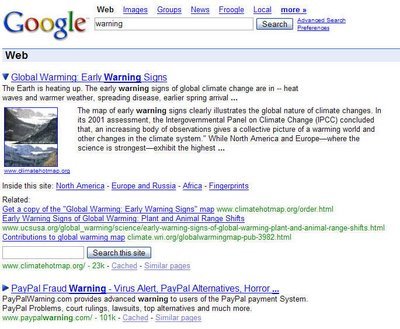
Screenshots Of Google’s New Search Results Screen
It appears that search engines are all doing some redesigns:
Yahoo is working on a new homepage, Microsoft is working on Windows Live, and now Google is redesigning their search layout. The new layout will provide more information to users about a site simply by selecting the expandable arrow. Once the arrow is selected then more information will be displayed about the site, including a longer description/summary and a related image. They will also include related links to that site to help users find the information they are looking for more quickly.
This is a good idea by Google because they are not cluttering up the page and at the same time they are providing more information. Here are some screenshots on what to expect:


Yahoo is working on a new homepage, Microsoft is working on Windows Live, and now Google is redesigning their search layout. The new layout will provide more information to users about a site simply by selecting the expandable arrow. Once the arrow is selected then more information will be displayed about the site, including a longer description/summary and a related image. They will also include related links to that site to help users find the information they are looking for more quickly.
This is a good idea by Google because they are not cluttering up the page and at the same time they are providing more information. Here are some screenshots on what to expect:


Friday, April 21, 2006
Google and the Orion Algorithm
Google Inc. has acquired "Orion" search engine technology from an Australian university that last year described the product as potentially revolutionary.
The software's inventor, Ori Allon, is now an employee of Google. "Orion" is a complement for queries running on search engines such Google, Yahoo Inc. and MSN Search.
Orion provides an expanded text excerpt from the list of web site results so the user does not have to click over multiple web pages to see the information relevant to a search query. It also displays results which are topically related to the keywords the user entered. This helps you gain additional information you might not have originally conceived, thus offering an expert search without having an expert's knowledge.
What Will the Search Results Look Like?
Search engine companies recognize that their engines need to move away from the model of providing long lists of search results, and instead aim to provide the specific facts users want. To varying degrees, major search engines deliver a digest of information collated from various online sources, particularly for queries involving news, weather, movies, actors, celebrities, and geographical locations.
To some degree Ask.com provides this function. Go to Ask.com and search ‘Virginia’. On the left there are alternative categories related to ‘Virginia’ under ‘Narrow Your Search’, ‘Expand Your Search’ and ‘Related Names’. I wonder what the ‘big three’ search engines are going to do with their sponsored ad space? I doubt Google will depart from their right-side browser display. If results are included in the organic or main text display area, then we are looking at expanded page scroll.
How Can I Prepare for the Orion Algorithm?
We do not believe that the implementation of ‘Orion’ will negatively impact web sites that have good ranking, quality links and great content. In fact, links and content will even become a more important issue to consider. A few basic search engine optimization rules will never change, that the consistent amount of traffic a web site receives in combination with textual content, in-bound links and out-bound links will remain the benchmark for good ranking.
About the Author
Ricardo Vidallon is owner and creative director for http://www.visionefx.net
The software's inventor, Ori Allon, is now an employee of Google. "Orion" is a complement for queries running on search engines such Google, Yahoo Inc. and MSN Search.
Orion provides an expanded text excerpt from the list of web site results so the user does not have to click over multiple web pages to see the information relevant to a search query. It also displays results which are topically related to the keywords the user entered. This helps you gain additional information you might not have originally conceived, thus offering an expert search without having an expert's knowledge.
What Will the Search Results Look Like?
Search engine companies recognize that their engines need to move away from the model of providing long lists of search results, and instead aim to provide the specific facts users want. To varying degrees, major search engines deliver a digest of information collated from various online sources, particularly for queries involving news, weather, movies, actors, celebrities, and geographical locations.
To some degree Ask.com provides this function. Go to Ask.com and search ‘Virginia’. On the left there are alternative categories related to ‘Virginia’ under ‘Narrow Your Search’, ‘Expand Your Search’ and ‘Related Names’. I wonder what the ‘big three’ search engines are going to do with their sponsored ad space? I doubt Google will depart from their right-side browser display. If results are included in the organic or main text display area, then we are looking at expanded page scroll.
How Can I Prepare for the Orion Algorithm?
We do not believe that the implementation of ‘Orion’ will negatively impact web sites that have good ranking, quality links and great content. In fact, links and content will even become a more important issue to consider. A few basic search engine optimization rules will never change, that the consistent amount of traffic a web site receives in combination with textual content, in-bound links and out-bound links will remain the benchmark for good ranking.
About the Author
Ricardo Vidallon is owner and creative director for http://www.visionefx.net
Tuesday, April 18, 2006
GOOGLE ACQUIRES AUSTRALIAN TECHNOLOGY
 MOUNTAIN VIEW - 04/17/06 - Google Inc. has acquired "Orion" search engine technology from an Australian university that the institution described last year as potentially revolutionary, reports the IDG News Service.
Google has also reportedly hired the PhD student who developed the technology. The Orion acquisition and Allon's hiring happened "months ago," the spokesman wrote, but news about this issue began to surface in recent days, starting with reports from media outlets in Australia and Israel, the student's native country, IDG rexcently reported.
In a press release issued last September, the University of New South Wales in Sydney called "Orion" a "complement for queries run on search engines such as ones from Google, Yahoo Inc. and Microsoft Corp."
Orion provides an expanded text excerpt from the list of Web site results, so that the user doesn't necessarily have to click over to those pages to see the information relevant to his query, according to the university, the release said.
It also displays results which are topically related to the keywords the user entered, even if those keywords aren't found in those related pages "thus offering an expert search without having an expert's knowledge," according to the statement.
The functionality, as described, seems to resemble a feature other search engines already offer by suggesting alternative queries to refine search results.
For example, when users run a query on IAC/InterActiveCorp's Ask.com, they get a conventional list of results, but they also receive a list of suggestions for narrowing and expanding the query's thematic scope. They also get a list of keywords that are potentially related to the query.
Through such features, search engines aim to address the problem of queries that return hundreds of thousands and even millions of results, forcing users to wade through many Web pages to find the information they are seeking.
Search engine operators recognize that their engines need to move away from the model of providing long lists of search results, and instead aim to provide the specific facts users want, say industry analysts.
To different degrees, most major search engines now sometimes deliver a digest of information collated from various online sources, particularly for queries involving weather, movies, famous people, and geographical locations.
Thursday, April 06, 2006
Google Algorithm Problems
by Rodney Ringler
Have you noticed anything different with Google lately? The Webmaster community certainly has, and if recent talk on several search engine optimization (SEO) forums is an indicator, Webmasters are very frustrated. For approximately two years Google has introduced a series of algorithm and filter changes that have led to unpredictable search engine results, and many clean (non-spam) websites have been dropped from the rankings. Google updates used to be monthly, and then quarterly. Now with so many servers, there seems to be several different search engine results rolling through the servers at any time during a quarter. Part of this is the recent Big Daddy update, which is a Google infrastructure update as much as an algorithm update. We believe Big Daddy is using a 64 bit architecture. Pages seem to go from a first page ranking to a spot on the 100th page, or worse yet to the Supplemental index. Google algorithm changes started in November 2003 with the Florida update, which now ranks as a legendary event in the Webmaster community. Then came updates named Austin, Brandy, Bourbon, and Jagger. Now we are dealing with the BigDaddy!
The algorithm problems seem to fall into 4 categories. There are canonical issues, duplicate content issues, the Sandbox, and supplemental page issues
1. Canonical Issues: These occur when a search engine treats www.yourdomain.com, yourdomain.com, and yourdomain.com/index.html all as different websites. When Google does this, it then flags the different copies as duplicate content and penalizes them. Also, if the site not penalized is http://yourdomain.com, but all of the websites link to your website using www.yourdomain.com, then the version left in the index will have no ranking. These are basic issues that other major search engines, such as Yahoo and MSN, have no problem dealing with. Google is possibly the greatest search engine in the world (ranking themselves as a 10 on a scale of 1 to 10). They provide tremendous results for a wide range of topics, and yet they cannot get some basic indexing issues resolved.
2. The Sandbox: This has become one of the legends of the search engine world. It appears that websites, or links to them, are "sandboxed" for a period before they are given full rank in the index, kind of like a maturing time. Some even think it is only applied to a set of competitive keywords, because they were the ones being manipulated the most. The Sandbox existence is debated, and Google has never officially confirmed it. The hypothesis behind the Sandbox is that Google knows that someone cannot create a 100,000 page website overnight, so they have implemented a type of time penalty for new links and sites before fully making the index.
3. Duplicate Content Issues: These have become a major issue on the Internet. Because web pages drive search engine rankings, black hat SEOs (search engine optimizers) started duplicating entire sites' content under their own domain name, thereby instantly producing a ton of web pages (an example of this would be to download an Encyclopedia onto your website). As a result of this abuse, Google aggressively attacked duplicate content abusers with their algorithm updates. But in the process they knocked out many legitimate sites as collateral damage. One example occurs when someone scrapes your website. Google sees both sites and may determine the legitimate one to be the duplicate. About the only thing a Webmaster can do is track down these sites as they are scraped, and submit a spam report to Google. Another big issue with duplicate content is that there are a lot of legitimate uses of duplicate content. News feeds are the most obvious example. A news story is covered by many websites because it is content the viewers want. Any filter will inevitably catch some legitimate uses.
4. Supplemental Page Issues: Webmasters fondly refer to this as Supplemental Hell. This issue has been reported on places like WebmasterWorld for over a year, but a major shake up around February 23rd has led to a huge outcry from the Webmaster community. This recent shakeup was part of the ongoing BigDaddy rollout that should finish this month. This issue is still unclear, but here is what we know. Google has 2 indexes: the Main index that you get when you search, and the Supplemental index that contains pages that are old, no longer active, have received errors, etc. The Supplemental index is a type of graveyard where web pages go when they are no longer deemed active. No one disputes the need for a Supplemental index. The problem, though, is that active, recent, and clean pages have been showing up in the Supplemental index. Like a dungeon, once they go in, they rarely come out. This issue has been reported with a low noise level for over a year, but the recent February upset has led to a lot of discussion around it. There is not a lot we know about this issue, and no one can seem to find a common cause leading to it.
Google updates were once fairly predictable, with monthly updates that Webmasters anticipated with both joy and angst. Google followed a well published algorithm that gave each website a Page Rank, which is a number given to each webpage based on the number and rank of other web pages pointing to it. When someone searches on a term, all of the web pages deemed relevant are then ordered by their Page Rank.
Google uses a number of factors such as keyword density, page titles, meta tags, and header tags to determine which pages are relevant. This original algorithm favored incoming links and the anchor text of them. The more links you got with an anchor text, the better you ranked for that keyword. As Google gained the bulk of internet searches in the early part of the decade, ranking well in their engine became highly coveted. Add to this the release of Google's Adsense program, and it became very lucrative. If a website could rank high for a popular keyword, they could run Google ads under Adsense and split the revenue with Google!
This combination led to an avalanche of SEO'ing like the Webmaster world had never seen. The whole nature of links between websites changed. Websites used to link to one another because it was good information for their visitors. But now that link to another website could reduce your search engine rankings, and if it is a link to a competitor, it might boost his. In Google's algorithm, links coming into your website boost the site's PageRank (PR), while links from your web pages to other sites reduce your PR. People started creating link farms, doing reciprocal link partnerships, and buying/selling links. Webmasters started linking to each other for mutual ranking help or money, instead of quality content for their visitors. This also led to the wholesale scraping of websites. Black hat SEO's will take the whole content of a website, put Google's ad on it, get a few high powered incoming links, and the next thing you know they are ranking high in Google and generating revenue from Google's Adsense without providing any unique website content.
Worse yet, as Google tries to go after this duplicate content, they sometimes get the real company instead of the scraper. This is all part of the cat and mouse game that has become the Google algorithm. Once Google realized the manipulation that was happening, they decided to aggressively alter their algorithms to prevent it. After all, their goal is to find the most relevant results for their searchers. At the same time, they also faced huge growth with the internet explosion. This has led to a period of unstable updates, causing many top ranking websites to disappear while many spam and scraped websites remain. In spite of Google's efforts, every change seems to catch more quality websites. Many spam sites and websites that violate Google's guidelines are caught, but there is an endless tide of more spam websites taking their place.
Some people might believe that this is not a problem. Google is there to provide the best relevant listings for what people are searching on, and for the most part the end user has not noticed an issue with Google's listings. If they only drop thousands of listings out of millions, then the results are still very good. These problems may not be affecting Google's bottom line now, but having a search engine that cannot be evolved without producing unintended results will hurt them over time in several ways.
First, as the competition from MSN and Yahoo grows, having the best results will no longer be a given, and these drops in quality listings will hurt them. Next, to stay competitive Google will need to continue to change their algorithms. This will be harder if they cannot make changes without producing unintended results. Finally, having the Webmaster community lose faith in them will make them vulnerable to competition. Webmasters provide Google with two things. They are the word of mouth experts. Also, they run the websites that use Google's Adsense program. Unlike other monopolies, it is easy to switch search engines. People might also criticize Webmasters for relying on a business model that requires free search engine traffic. Fluctuations in ranking are part of the internet business, and most Webmasters realize this. Webmasters are simply asking Google to fix bugs that cause unintended issues with their sites.
Most Webmasters may blame ranking losses on Google and their bugs. But the truth is that many Webmasters do violate some of the guidelines that Google lays out. Most consider it harmless to bend the rules a little, and assume this is not the reason their websites have issues. In some cases, though, Google is right and has just tweaked its algorithm in the right direction. Here is an example: Google seems to be watching the incoming links to your site to make sure they don't have the same anchor text (this is the text used in the link on the website linking to you). If too many links use the same anchor text, Google discounts these links. This was originally done by some people to inflate their rankings. Other people did it because one anchor text usually makes sense. This is not really a black hat SEO trick, and it is not called out in Google's guidelines, but it has caused some websites to lose rank.
Webmasters realize that Google needs to fight spam and black hat SEO manipulation. And to their credit, there is a Google Engineer named Matt Cutts who has a Blog site and participates in SEO forums to assist Webmasters. But given the revenue impact that Google rankings have on companies, Webmasters would like to see even more communication around the known issues, and help with identifying future algorithm issues. No one expects Google to reveal their algorithm or what changes they are making. Rumor on the forum boards speculates that Google is currently looking at items like the age of the domain name, websites on the same IP, and frequency of fresh content. It would be nice from a Webmaster standpoint to be able to report potential bugs to Google, and get a response. It is in Google's best interest to have a bug free algorithm. This will in turn provide the best search engine results for everyone.
About The AuthorRodney Ringler is President of Advantage1 Web Services, Inc., which owns a network of Web Hosting Informational Websites including Hostchart.com, Resellerconnection.com, Foundhost.com and Resellerforums.com.
Have you noticed anything different with Google lately? The Webmaster community certainly has, and if recent talk on several search engine optimization (SEO) forums is an indicator, Webmasters are very frustrated. For approximately two years Google has introduced a series of algorithm and filter changes that have led to unpredictable search engine results, and many clean (non-spam) websites have been dropped from the rankings. Google updates used to be monthly, and then quarterly. Now with so many servers, there seems to be several different search engine results rolling through the servers at any time during a quarter. Part of this is the recent Big Daddy update, which is a Google infrastructure update as much as an algorithm update. We believe Big Daddy is using a 64 bit architecture. Pages seem to go from a first page ranking to a spot on the 100th page, or worse yet to the Supplemental index. Google algorithm changes started in November 2003 with the Florida update, which now ranks as a legendary event in the Webmaster community. Then came updates named Austin, Brandy, Bourbon, and Jagger. Now we are dealing with the BigDaddy!
The algorithm problems seem to fall into 4 categories. There are canonical issues, duplicate content issues, the Sandbox, and supplemental page issues
1. Canonical Issues: These occur when a search engine treats www.yourdomain.com, yourdomain.com, and yourdomain.com/index.html all as different websites. When Google does this, it then flags the different copies as duplicate content and penalizes them. Also, if the site not penalized is http://yourdomain.com, but all of the websites link to your website using www.yourdomain.com, then the version left in the index will have no ranking. These are basic issues that other major search engines, such as Yahoo and MSN, have no problem dealing with. Google is possibly the greatest search engine in the world (ranking themselves as a 10 on a scale of 1 to 10). They provide tremendous results for a wide range of topics, and yet they cannot get some basic indexing issues resolved.
2. The Sandbox: This has become one of the legends of the search engine world. It appears that websites, or links to them, are "sandboxed" for a period before they are given full rank in the index, kind of like a maturing time. Some even think it is only applied to a set of competitive keywords, because they were the ones being manipulated the most. The Sandbox existence is debated, and Google has never officially confirmed it. The hypothesis behind the Sandbox is that Google knows that someone cannot create a 100,000 page website overnight, so they have implemented a type of time penalty for new links and sites before fully making the index.
3. Duplicate Content Issues: These have become a major issue on the Internet. Because web pages drive search engine rankings, black hat SEOs (search engine optimizers) started duplicating entire sites' content under their own domain name, thereby instantly producing a ton of web pages (an example of this would be to download an Encyclopedia onto your website). As a result of this abuse, Google aggressively attacked duplicate content abusers with their algorithm updates. But in the process they knocked out many legitimate sites as collateral damage. One example occurs when someone scrapes your website. Google sees both sites and may determine the legitimate one to be the duplicate. About the only thing a Webmaster can do is track down these sites as they are scraped, and submit a spam report to Google. Another big issue with duplicate content is that there are a lot of legitimate uses of duplicate content. News feeds are the most obvious example. A news story is covered by many websites because it is content the viewers want. Any filter will inevitably catch some legitimate uses.
4. Supplemental Page Issues: Webmasters fondly refer to this as Supplemental Hell. This issue has been reported on places like WebmasterWorld for over a year, but a major shake up around February 23rd has led to a huge outcry from the Webmaster community. This recent shakeup was part of the ongoing BigDaddy rollout that should finish this month. This issue is still unclear, but here is what we know. Google has 2 indexes: the Main index that you get when you search, and the Supplemental index that contains pages that are old, no longer active, have received errors, etc. The Supplemental index is a type of graveyard where web pages go when they are no longer deemed active. No one disputes the need for a Supplemental index. The problem, though, is that active, recent, and clean pages have been showing up in the Supplemental index. Like a dungeon, once they go in, they rarely come out. This issue has been reported with a low noise level for over a year, but the recent February upset has led to a lot of discussion around it. There is not a lot we know about this issue, and no one can seem to find a common cause leading to it.
Google updates were once fairly predictable, with monthly updates that Webmasters anticipated with both joy and angst. Google followed a well published algorithm that gave each website a Page Rank, which is a number given to each webpage based on the number and rank of other web pages pointing to it. When someone searches on a term, all of the web pages deemed relevant are then ordered by their Page Rank.
Google uses a number of factors such as keyword density, page titles, meta tags, and header tags to determine which pages are relevant. This original algorithm favored incoming links and the anchor text of them. The more links you got with an anchor text, the better you ranked for that keyword. As Google gained the bulk of internet searches in the early part of the decade, ranking well in their engine became highly coveted. Add to this the release of Google's Adsense program, and it became very lucrative. If a website could rank high for a popular keyword, they could run Google ads under Adsense and split the revenue with Google!
This combination led to an avalanche of SEO'ing like the Webmaster world had never seen. The whole nature of links between websites changed. Websites used to link to one another because it was good information for their visitors. But now that link to another website could reduce your search engine rankings, and if it is a link to a competitor, it might boost his. In Google's algorithm, links coming into your website boost the site's PageRank (PR), while links from your web pages to other sites reduce your PR. People started creating link farms, doing reciprocal link partnerships, and buying/selling links. Webmasters started linking to each other for mutual ranking help or money, instead of quality content for their visitors. This also led to the wholesale scraping of websites. Black hat SEO's will take the whole content of a website, put Google's ad on it, get a few high powered incoming links, and the next thing you know they are ranking high in Google and generating revenue from Google's Adsense without providing any unique website content.
Worse yet, as Google tries to go after this duplicate content, they sometimes get the real company instead of the scraper. This is all part of the cat and mouse game that has become the Google algorithm. Once Google realized the manipulation that was happening, they decided to aggressively alter their algorithms to prevent it. After all, their goal is to find the most relevant results for their searchers. At the same time, they also faced huge growth with the internet explosion. This has led to a period of unstable updates, causing many top ranking websites to disappear while many spam and scraped websites remain. In spite of Google's efforts, every change seems to catch more quality websites. Many spam sites and websites that violate Google's guidelines are caught, but there is an endless tide of more spam websites taking their place.
Some people might believe that this is not a problem. Google is there to provide the best relevant listings for what people are searching on, and for the most part the end user has not noticed an issue with Google's listings. If they only drop thousands of listings out of millions, then the results are still very good. These problems may not be affecting Google's bottom line now, but having a search engine that cannot be evolved without producing unintended results will hurt them over time in several ways.
First, as the competition from MSN and Yahoo grows, having the best results will no longer be a given, and these drops in quality listings will hurt them. Next, to stay competitive Google will need to continue to change their algorithms. This will be harder if they cannot make changes without producing unintended results. Finally, having the Webmaster community lose faith in them will make them vulnerable to competition. Webmasters provide Google with two things. They are the word of mouth experts. Also, they run the websites that use Google's Adsense program. Unlike other monopolies, it is easy to switch search engines. People might also criticize Webmasters for relying on a business model that requires free search engine traffic. Fluctuations in ranking are part of the internet business, and most Webmasters realize this. Webmasters are simply asking Google to fix bugs that cause unintended issues with their sites.
Most Webmasters may blame ranking losses on Google and their bugs. But the truth is that many Webmasters do violate some of the guidelines that Google lays out. Most consider it harmless to bend the rules a little, and assume this is not the reason their websites have issues. In some cases, though, Google is right and has just tweaked its algorithm in the right direction. Here is an example: Google seems to be watching the incoming links to your site to make sure they don't have the same anchor text (this is the text used in the link on the website linking to you). If too many links use the same anchor text, Google discounts these links. This was originally done by some people to inflate their rankings. Other people did it because one anchor text usually makes sense. This is not really a black hat SEO trick, and it is not called out in Google's guidelines, but it has caused some websites to lose rank.
Webmasters realize that Google needs to fight spam and black hat SEO manipulation. And to their credit, there is a Google Engineer named Matt Cutts who has a Blog site and participates in SEO forums to assist Webmasters. But given the revenue impact that Google rankings have on companies, Webmasters would like to see even more communication around the known issues, and help with identifying future algorithm issues. No one expects Google to reveal their algorithm or what changes they are making. Rumor on the forum boards speculates that Google is currently looking at items like the age of the domain name, websites on the same IP, and frequency of fresh content. It would be nice from a Webmaster standpoint to be able to report potential bugs to Google, and get a response. It is in Google's best interest to have a bug free algorithm. This will in turn provide the best search engine results for everyone.
About The AuthorRodney Ringler is President of Advantage1 Web Services, Inc., which owns a network of Web Hosting Informational Websites including Hostchart.com, Resellerconnection.com, Foundhost.com and Resellerforums.com.
Tuesday, April 04, 2006
Can duplicate content influence your rankings?
Every few months, webmaster forums discuss if search engines penalize duplicate content.
Duplicate content can happen if web pages publish the same articles, if different domains point to the same web space or if webmasters steal the content of other pages. If two shops sell the same item and use similar shop systems, some product pages can also look like duplicated web pages.
Is there really a penalty for duplicate content?
There are many opinions in the discussion forums but there's no proof that search engines really penalize duplicate content.
If there really was a duplicate content filter then many news web sites that publish AP or
Reuters news would be banned from search engines. For example, you can find many web pages with exactly the same article here. All pages can be found on Google.
However, many people insist that a duplicate content filter exists.
Why do people think that there's a duplicate content penalty?
Some people think that there is a duplicate content penalty because a web page that shows a special article might have a Google PageRank 0 and another web page with the same article might have a Google PageRank 5.
Not all web pages with the same content have the same search engine rankings. If a web site is older than another, if it has better inbound links and if that site has more content than it's likely that it will get better rankings than another page that lists the same article.
That doesn't mean that the web site with the worse ranking has been penalized. It just means that the other web site probably has more links and that the page is more trustworthy to search engines.
Some people think that there must be a duplicate content filter because additional domain names that point to the same web space as the main domain name are usually not listed on search engines.
This is not due to a duplicate content filter. It's an issue with canonical URLs. Google has addressed that problem with their latest ranking algorithm update.
Whether there is a duplicate content penalty or not has yet to be proved. If you want to outperform your competition on search engines, make sure that your web site has unique content that cannot be found on other sites.
If your web site has unique content, you don't have to worry about potential duplicate content penalties. Optimize that content for search engines and make sure that your web site has good inbound links.
It's hard to beat a web site with great optimized content and many good inbound links.
Duplicate content can happen if web pages publish the same articles, if different domains point to the same web space or if webmasters steal the content of other pages. If two shops sell the same item and use similar shop systems, some product pages can also look like duplicated web pages.
Is there really a penalty for duplicate content?
There are many opinions in the discussion forums but there's no proof that search engines really penalize duplicate content.
If there really was a duplicate content filter then many news web sites that publish AP or
Reuters news would be banned from search engines. For example, you can find many web pages with exactly the same article here. All pages can be found on Google.
However, many people insist that a duplicate content filter exists.
Why do people think that there's a duplicate content penalty?
Some people think that there is a duplicate content penalty because a web page that shows a special article might have a Google PageRank 0 and another web page with the same article might have a Google PageRank 5.
Not all web pages with the same content have the same search engine rankings. If a web site is older than another, if it has better inbound links and if that site has more content than it's likely that it will get better rankings than another page that lists the same article.
That doesn't mean that the web site with the worse ranking has been penalized. It just means that the other web site probably has more links and that the page is more trustworthy to search engines.
Some people think that there must be a duplicate content filter because additional domain names that point to the same web space as the main domain name are usually not listed on search engines.
This is not due to a duplicate content filter. It's an issue with canonical URLs. Google has addressed that problem with their latest ranking algorithm update.
Whether there is a duplicate content penalty or not has yet to be proved. If you want to outperform your competition on search engines, make sure that your web site has unique content that cannot be found on other sites.
If your web site has unique content, you don't have to worry about potential duplicate content penalties. Optimize that content for search engines and make sure that your web site has good inbound links.
It's hard to beat a web site with great optimized content and many good inbound links.
Wednesday, March 29, 2006
SEO For MSN
This is article one of a four part series on optimizing your website for the "Big Three". Part two will focus on Yahoo!, Part three will focus on Google and part four of this series will explain how to perform SEO on your website to attain high rankings across all three major engines. We are beginning with MSN as rankings are generally faster attained on this engine and thus it is a good place to begin, especially if you have a new site that is likely still in the sandbox on Google or are just at the beginning stages of link building.Like all of the major search engines, MSN builds their index of sites using spiders to crawl the web finding new and changed information. This information is then processed by the MSN servers using complex algorithms to determine which sites are most relevant to the search query entered.
This may seem like an extraordinarily complex process and it is however the resulting environment is simple: all search engine algorithms are mathematical and thus, there is a fixed set of rules and factors which, if addressed correctly, will result in a high ranking. In short, because it's math we have the benefit of knowing that if we take action x and action y we will get results.
The Rules For MSN
Assuming that you are following the right rules, the results you can achieve on MSN can be fast and solid. MSN does not apply the same types of aging delays that the other two engines do and thus, when you change your content the change in results can be realized as quickly as they reindex your site and as quickly as your incoming links get picked. This differs greatly from Google and Yahoo! in that those two engines age both domains and links requiring a longer period of time before the full effects of your efforts are realized.
As an additional note on MSN, users of MSN are 48% more likely to purchase a product or service online than the average Internet user according to a comScore Media report.
So what are the rules for MSN that can help us get top rankings? As with all the major engines, there are two fundamental areas that need to be addressed to attain top rankings. The first is the onsite factors, the second is the offsite. Because they are fundamentally different we will address them separately.
Onsite SEO Factors
The problem with writing an article about the onsite factors is that by the time many of you read this some of the weight these factors hold and the optimal levels noted may well be out-of-date. Thus, rather than listing overly-specific-and-sure-to-change factors we will focus on how to know what the factors are, how to get a handle on what you need to adjust and by how much, and how to predict what will be coming down the road. And so we'll begin:
How To Know What The Factors Are:
Unfortunately there's no one over at MSN Search calling us up weekly to let us know what the specifics of their algorithm are, we have to figure it out for ourselves with research, reading and playing with test sites. From all of this there is only one conclusion that an SEO can make: the details matter. When we're discussing onsite factors this includes:
* the content of the page including keyword density
* the internal linking structure of the site (how the pages of your site are linked together)
* the number of pages in your site and the relevancy of those pages to your main topic and phrases
* the use of titles, heading tags and special formats
There are a number of lower weight factors however the ones noted above, if addressed correctly, will have very significant results on your rankings if the offsite factors noted below are also addressed.
Page Content:
The content of your page must be perfect. What I mean by this is that the content must appeal to both the search engines and the algorithms. In order to write properly for the visitors you must be able to write clearly and in language that is both appealing and understandable to your target market. While there is much debate about whether the keyword density of your page is important I am certainly one who believes that it is. It only makes sense that a part of the algorithm takes into account the use of the keywords on your page. Unfortunately the optimal keyword density changes slightly with each algorithm update and also by site type and field. For this reason it would be virtually impossible for me to give you a density that will work today and forevermore. For this reason you will need a keyword density analysis tool which you will want to run on your own site as well as the sites in the top 10 to assess what the optimal density is at this time. You may notice a variation in the densities of the top 10. This is due to the other factors including offsite which can give extra weight to even a poorly optimized site. I recommend getting your site to a keyword density close to the higher-end of the top 10 but not excessive. Traditionally this percentage will fall somewhere near 3.5 to 4% for MSN.
Internal Linking Structure:
The way your pages link together tells the search engines what the page is about and also allows them to easily (or not-so-easily) work their way to your internal pages. If your site has an image or script-based navigation it is important to also use text links either in your content, in a footer, or both. The text links are easy to follow for a spider and perhaps more importantly, the text links allow you the opportunity to tell the spiders what a specific page is about though the anchor text and, in the case of footers, allows you to add in more instances of the targeted phrases outside of your general content area.
The Number Of Pages & Their Relevancy:
MSN wants to please their visitors. For this reason they want to insure that highest likelihood that a searcher will find what they need once they get to your site. For this reason a larger site with unified content will rank higher that a smaller site or a site with varying content topics. (note: this assumes that all else is equal in regards to the other ranking factors)
When you are optimizing your site for MSN be sure to take some time to built quality content. Do a search on your major competitors to see how large their sites are, over time you will want to build yours to the same range through general content creation or the addition of a blog or forum to your site.
Titles, Heading Tags & Special Formats:
Titles are the single most important piece of code our your entire web page for two reasons. The first is that it holds a very high level of weight in the algorithm. the second reason is that it is your window to the world. When someone runs a search the results will generally show your page title in the search results. This means that a human visitor has to be drawn to click on your title or rankings your site is a futile effort (this isn't about bragging rights, it's about return on investment).
Heading tags are used to specify significant portions of content. The most commonly used is the H1 tag though there are obviously others (or they wouldn't bother numbering them would they). The H1 tag is given a significant amount of weight in the algorithm provided that it is not abused though overuse (it should only be used once per page). Try to keep your headings short-and-sweet. They're there to tell your visitor what the page is about, not your whole site.
Special formats are, for the purpose of this article, and text formatting that distinguishes a set of characters or words apart from the others. This includes such things as, anchor text, bold, italic, different font colors, etc. When you set content apart using special formats MSN will read this as a part of your content that you want to draw attention to and which you obviously want your visitors to see. This will increase the weight of that content. Now don't go making all your keyword bold or the such, simply make sure to use special formats properly. Inline text links (links in the body content of your page) is a great way to increase the weight of specific text while actually helping your visitor by providing easy paths to pages they may be interested in.
Offsite SEO Factors
With MSN, the offsite factors are much simpler to deal with than either Google or Yahoo! MSN will give you full credit for a link the day they pick it up so link building, while time consuming, is reworded much quicker on MSN. When dealing with MSN and offsite SEO there are two main factors we must consider when finding links:
* Relevancy. The site must be relevant to yours to hold any real weight.
* Quality is better than quantity. Because PageRank is Google-specific we can't use it as the grading tool for MSN however upon visiting a website it's generally fairly clear whether we're visiting a good site or not. Spending extra time to find quality is well rewarded. Also, finding one-way links as opposed to reciprocal links is becoming increasingly important and I'd recommend utilizing both in your link building strategies.
You will have to begin your offsite optimization by running link checks on your competitors to see what you're up against. This is also a good place to start for potential link partners though those of you using a tool such as Total Optimizer Pro or PR Prowler will find it far faster and more effective to use these tools.
Conclusion
This entire article may seem fairly simplistic and there's a reason for that, what we've noted above is a list of the more important areas however to save you frustration and me from receiving hundreds of emails a few months from now noting that the keyword densities don't work, etc. I've tried to keep it general. Below you'll find a list of recommended resources. These are tools and SEO resources to help keep you updated and on top of the rankings.
Next week we will be covering Yahoo!
Resources
Total Optimizer Pro - A keyword density and backlink analysis tool. This tool breaks down a variety of onsite and offsite factors giving you a full snapshot of how the top 10 got their positions.
Microsoft Press Room - Read the latest press releases from Microsoft. This may not give you the algorithm but it will tell you the direction they're going. Understand this and you'll be better equipped to deal with changes down the road.
SearchEngineWatch's MSN Forums - Read the latest news, feedback and discussions on the SearchEngineWatch forums. A great way to keep updated but beware, not everyone in there is a qualified opinion.
About This Author:
Dave Davies is the CEO of the SEO services firm Beanstalk Search Engine Positioning, Inc. Beanstalk provides guaranteed search engine positioning and SEO%20consulting[/url'>services to clients from around the world. If you're more interested in doing it yourself please visit our [url=http://www.beanstalk-inc.com/blog/]SEO news blog to keep updated on the latest goings-on in the search engine world.
This may seem like an extraordinarily complex process and it is however the resulting environment is simple: all search engine algorithms are mathematical and thus, there is a fixed set of rules and factors which, if addressed correctly, will result in a high ranking. In short, because it's math we have the benefit of knowing that if we take action x and action y we will get results.
The Rules For MSN
Assuming that you are following the right rules, the results you can achieve on MSN can be fast and solid. MSN does not apply the same types of aging delays that the other two engines do and thus, when you change your content the change in results can be realized as quickly as they reindex your site and as quickly as your incoming links get picked. This differs greatly from Google and Yahoo! in that those two engines age both domains and links requiring a longer period of time before the full effects of your efforts are realized.
As an additional note on MSN, users of MSN are 48% more likely to purchase a product or service online than the average Internet user according to a comScore Media report.
So what are the rules for MSN that can help us get top rankings? As with all the major engines, there are two fundamental areas that need to be addressed to attain top rankings. The first is the onsite factors, the second is the offsite. Because they are fundamentally different we will address them separately.
Onsite SEO Factors
The problem with writing an article about the onsite factors is that by the time many of you read this some of the weight these factors hold and the optimal levels noted may well be out-of-date. Thus, rather than listing overly-specific-and-sure-to-change factors we will focus on how to know what the factors are, how to get a handle on what you need to adjust and by how much, and how to predict what will be coming down the road. And so we'll begin:
How To Know What The Factors Are:
Unfortunately there's no one over at MSN Search calling us up weekly to let us know what the specifics of their algorithm are, we have to figure it out for ourselves with research, reading and playing with test sites. From all of this there is only one conclusion that an SEO can make: the details matter. When we're discussing onsite factors this includes:
* the content of the page including keyword density
* the internal linking structure of the site (how the pages of your site are linked together)
* the number of pages in your site and the relevancy of those pages to your main topic and phrases
* the use of titles, heading tags and special formats
There are a number of lower weight factors however the ones noted above, if addressed correctly, will have very significant results on your rankings if the offsite factors noted below are also addressed.
Page Content:
The content of your page must be perfect. What I mean by this is that the content must appeal to both the search engines and the algorithms. In order to write properly for the visitors you must be able to write clearly and in language that is both appealing and understandable to your target market. While there is much debate about whether the keyword density of your page is important I am certainly one who believes that it is. It only makes sense that a part of the algorithm takes into account the use of the keywords on your page. Unfortunately the optimal keyword density changes slightly with each algorithm update and also by site type and field. For this reason it would be virtually impossible for me to give you a density that will work today and forevermore. For this reason you will need a keyword density analysis tool which you will want to run on your own site as well as the sites in the top 10 to assess what the optimal density is at this time. You may notice a variation in the densities of the top 10. This is due to the other factors including offsite which can give extra weight to even a poorly optimized site. I recommend getting your site to a keyword density close to the higher-end of the top 10 but not excessive. Traditionally this percentage will fall somewhere near 3.5 to 4% for MSN.
Internal Linking Structure:
The way your pages link together tells the search engines what the page is about and also allows them to easily (or not-so-easily) work their way to your internal pages. If your site has an image or script-based navigation it is important to also use text links either in your content, in a footer, or both. The text links are easy to follow for a spider and perhaps more importantly, the text links allow you the opportunity to tell the spiders what a specific page is about though the anchor text and, in the case of footers, allows you to add in more instances of the targeted phrases outside of your general content area.
The Number Of Pages & Their Relevancy:
MSN wants to please their visitors. For this reason they want to insure that highest likelihood that a searcher will find what they need once they get to your site. For this reason a larger site with unified content will rank higher that a smaller site or a site with varying content topics. (note: this assumes that all else is equal in regards to the other ranking factors)
When you are optimizing your site for MSN be sure to take some time to built quality content. Do a search on your major competitors to see how large their sites are, over time you will want to build yours to the same range through general content creation or the addition of a blog or forum to your site.
Titles, Heading Tags & Special Formats:
Titles are the single most important piece of code our your entire web page for two reasons. The first is that it holds a very high level of weight in the algorithm. the second reason is that it is your window to the world. When someone runs a search the results will generally show your page title in the search results. This means that a human visitor has to be drawn to click on your title or rankings your site is a futile effort (this isn't about bragging rights, it's about return on investment).
Heading tags are used to specify significant portions of content. The most commonly used is the H1 tag though there are obviously others (or they wouldn't bother numbering them would they). The H1 tag is given a significant amount of weight in the algorithm provided that it is not abused though overuse (it should only be used once per page). Try to keep your headings short-and-sweet. They're there to tell your visitor what the page is about, not your whole site.
Special formats are, for the purpose of this article, and text formatting that distinguishes a set of characters or words apart from the others. This includes such things as, anchor text, bold, italic, different font colors, etc. When you set content apart using special formats MSN will read this as a part of your content that you want to draw attention to and which you obviously want your visitors to see. This will increase the weight of that content. Now don't go making all your keyword bold or the such, simply make sure to use special formats properly. Inline text links (links in the body content of your page) is a great way to increase the weight of specific text while actually helping your visitor by providing easy paths to pages they may be interested in.
Offsite SEO Factors
With MSN, the offsite factors are much simpler to deal with than either Google or Yahoo! MSN will give you full credit for a link the day they pick it up so link building, while time consuming, is reworded much quicker on MSN. When dealing with MSN and offsite SEO there are two main factors we must consider when finding links:
* Relevancy. The site must be relevant to yours to hold any real weight.
* Quality is better than quantity. Because PageRank is Google-specific we can't use it as the grading tool for MSN however upon visiting a website it's generally fairly clear whether we're visiting a good site or not. Spending extra time to find quality is well rewarded. Also, finding one-way links as opposed to reciprocal links is becoming increasingly important and I'd recommend utilizing both in your link building strategies.
You will have to begin your offsite optimization by running link checks on your competitors to see what you're up against. This is also a good place to start for potential link partners though those of you using a tool such as Total Optimizer Pro or PR Prowler will find it far faster and more effective to use these tools.
Conclusion
This entire article may seem fairly simplistic and there's a reason for that, what we've noted above is a list of the more important areas however to save you frustration and me from receiving hundreds of emails a few months from now noting that the keyword densities don't work, etc. I've tried to keep it general. Below you'll find a list of recommended resources. These are tools and SEO resources to help keep you updated and on top of the rankings.
Next week we will be covering Yahoo!
Resources
Total Optimizer Pro - A keyword density and backlink analysis tool. This tool breaks down a variety of onsite and offsite factors giving you a full snapshot of how the top 10 got their positions.
Microsoft Press Room - Read the latest press releases from Microsoft. This may not give you the algorithm but it will tell you the direction they're going. Understand this and you'll be better equipped to deal with changes down the road.
SearchEngineWatch's MSN Forums - Read the latest news, feedback and discussions on the SearchEngineWatch forums. A great way to keep updated but beware, not everyone in there is a qualified opinion.
About This Author:
Dave Davies is the CEO of the SEO services firm Beanstalk Search Engine Positioning, Inc. Beanstalk provides guaranteed search engine positioning and SEO%20consulting[/url'>services to clients from around the world. If you're more interested in doing it yourself please visit our [url=http://www.beanstalk-inc.com/blog/]SEO news blog to keep updated on the latest goings-on in the search engine world.
Sunday, March 19, 2006
Rant and Rave About Google
Rant and Rave About Google
The Search
I recently purchased a book called "The Search" by John Battelle that explores how Google and its rivals rewrote the rules of business and transformed our culture. What really caught my attention was Chapter 7 titled The Search Economy. It related how a small e-commerce store got yanked by the short-hairs when Google made an unexpected algorithm change in 2003 virtually wiped out their business.
Google did it again in late 2005, and will no doubt do it again and again and again. Rumor has it that it will happen again in March 2006.
Google Giveth, Google Taketh Away
Those of you who are webmasters already know how this happens. Some eager beaver group of Google engineers laid waste to thousands of mom and pop businesses by tweaking Google’s indexing algorithm. These businesses depended on their Google listings for their income and livelihoods. Google giveth and Google taketh away.
Knowing that the Google paradigm will always change puts you ahead of the pack; not putting all your marketing eggs in one basket will keep you there.
Your unpaid or "organic" rankings in search engines are free. But how many times have you heard the axiom "there's no such thing as a free lunch."
Starting to get the picture now?
Google Still Likes Links
I've been getting tons of automated requests for two-way and three-way linking. I can't believe what these people are thinking. The rules are displayed in black and white on Google's web site. Allow me to paraphrase "Build pages for users, not search engines."
Here's a typical email I get every day:
Hello Sir/Madam,I'm mailing you for exchanging three-way link with your site. Though we are accustomed with reciprocal link exchange, the fact is that three-way link is always better than reciprocal link exchange, as all search engines give more attention to three-way links.When search engines can't trace a link back from one site to another it thinks that site is very important so other site is linking to it just like we use google or yahoo in our website.
Do these bozos really believe this?
Fact of the matter is you should link to a website that you believe will be of value to your website viewer’s. That’s it. No schemes, no tricks, no 2, 3, 4, 5 or 6 way linking. Provide your visitors good content and good links. Period.
Vertical Channels and Directories
Web sites like Global Spec (for engineers) and Find Law (for lawyers) are quasi-vertical advertising channels and global directories. Vertical marketing is a great way to target business in the same genre that you practice and participate. It’s also a great way for regional companies to inexpensively obtain entry into new markets or regions.
For web guys like myself, there are similar verticals or directories such as Marketing Tool, Xemion, and Top Web Designers. But here’s the rub. These directories have an unfair advantage in the linking scheme of Google. But who said life is fair.
Directories have "muddied the Internet waters." With so many links from so many sites across so many states, it is the equivalent of being a 500-pound linking gorilla. I keep hoping that the next Google dance will place these linking monsters accordingly, but that has yet to happen. Once everyone catches onto this flawed "link ranking" scheme, a search for any term or phrase in Google will provide you nothing but a page full of directories.
Pure Search
This leads to my next point. Say I have an xyz disease (God forbid). If I search "xyz disease nutrition" in Google, I want to find web sites about xyz disease nutrition, or battling xyz disease with proper diet and so on. I don’t want to see a directory full of re-packaged information, filled with ads, newsletters and other useless directory fluff.
I want my search engine to emulate the Library of Congress. Let's say the librarian says, "Books on xyz disease nutrition are located on isle 700b" on row 3. I stroll over to 700b row 3 and pull out a book that systematically lists all the books on 700b, row 3. Wait a second! This isn’t a book about xyz disease nutrition, it's a "directory" or reference book that belongs in the "reference section" of the library.
Are you listening Google?
Maybe Mr. Gates is.
Or better yet maybe Mr. Jobs has a trick or two left up his sleeve.iPod.com today iSearch.com tomorrow.
The Search
I recently purchased a book called "The Search" by John Battelle that explores how Google and its rivals rewrote the rules of business and transformed our culture. What really caught my attention was Chapter 7 titled The Search Economy. It related how a small e-commerce store got yanked by the short-hairs when Google made an unexpected algorithm change in 2003 virtually wiped out their business.
Google did it again in late 2005, and will no doubt do it again and again and again. Rumor has it that it will happen again in March 2006.
Google Giveth, Google Taketh Away
Those of you who are webmasters already know how this happens. Some eager beaver group of Google engineers laid waste to thousands of mom and pop businesses by tweaking Google’s indexing algorithm. These businesses depended on their Google listings for their income and livelihoods. Google giveth and Google taketh away.
Knowing that the Google paradigm will always change puts you ahead of the pack; not putting all your marketing eggs in one basket will keep you there.
Your unpaid or "organic" rankings in search engines are free. But how many times have you heard the axiom "there's no such thing as a free lunch."
Starting to get the picture now?
Google Still Likes Links
I've been getting tons of automated requests for two-way and three-way linking. I can't believe what these people are thinking. The rules are displayed in black and white on Google's web site. Allow me to paraphrase "Build pages for users, not search engines."
Here's a typical email I get every day:
Hello Sir/Madam,I'm mailing you for exchanging three-way link with your site. Though we are accustomed with reciprocal link exchange, the fact is that three-way link is always better than reciprocal link exchange, as all search engines give more attention to three-way links.When search engines can't trace a link back from one site to another it thinks that site is very important so other site is linking to it just like we use google or yahoo in our website.
Do these bozos really believe this?
Fact of the matter is you should link to a website that you believe will be of value to your website viewer’s. That’s it. No schemes, no tricks, no 2, 3, 4, 5 or 6 way linking. Provide your visitors good content and good links. Period.
Vertical Channels and Directories
Web sites like Global Spec (for engineers) and Find Law (for lawyers) are quasi-vertical advertising channels and global directories. Vertical marketing is a great way to target business in the same genre that you practice and participate. It’s also a great way for regional companies to inexpensively obtain entry into new markets or regions.
For web guys like myself, there are similar verticals or directories such as Marketing Tool, Xemion, and Top Web Designers. But here’s the rub. These directories have an unfair advantage in the linking scheme of Google. But who said life is fair.
Directories have "muddied the Internet waters." With so many links from so many sites across so many states, it is the equivalent of being a 500-pound linking gorilla. I keep hoping that the next Google dance will place these linking monsters accordingly, but that has yet to happen. Once everyone catches onto this flawed "link ranking" scheme, a search for any term or phrase in Google will provide you nothing but a page full of directories.
Pure Search
This leads to my next point. Say I have an xyz disease (God forbid). If I search "xyz disease nutrition" in Google, I want to find web sites about xyz disease nutrition, or battling xyz disease with proper diet and so on. I don’t want to see a directory full of re-packaged information, filled with ads, newsletters and other useless directory fluff.
I want my search engine to emulate the Library of Congress. Let's say the librarian says, "Books on xyz disease nutrition are located on isle 700b" on row 3. I stroll over to 700b row 3 and pull out a book that systematically lists all the books on 700b, row 3. Wait a second! This isn’t a book about xyz disease nutrition, it's a "directory" or reference book that belongs in the "reference section" of the library.
Are you listening Google?
Maybe Mr. Gates is.
Or better yet maybe Mr. Jobs has a trick or two left up his sleeve.iPod.com today iSearch.com tomorrow.
Wednesday, February 15, 2006
The Dark Side Of Google
By Christine Stander
The way that search marketers dream up conspiracy theories you'd think that we're all paranoid with nothing better to do.
Is there a true reason for concern? I think not, but reading other peoples paranoia is always entertaining. We all know search engines are "out to get webmasters". They have nothing better to do than to think of new ways that will infringe on websites rankings or play hide and seek with site PageRank.
Google is at the forefront of the theorists' attention. And it's not very hard to see why.
It's Tough Being At The Top
Google's market share is certainly growing. It handled 60 percent of Internet search queries in November 2005, up from 47 percent a year earlier, according to ComScore Networks. Google's chief officers have expressed that they are committed to growing the company itself in a sustainable way.
Quoting CFO George Reyes: "Google would be spending more on research and development, and will invest heavily in its computing infrastructure."
Google's motto "do no evil" has been analyzed and debated so many times. Forum posts and articles are always met with "Google does this" or "Google does that", the fact of the matter is that none of us know "what Google's intentions are, except Google themselves of course...but it's still nice to enter the guessing game to see exactly "how close, or far off" you are from the materialization.
Enter the Conspiracies
Everyone has their opinion on the matter - which makes for entertaining reading at least.
Jagger Update
The conspiracy: Google is out to destroy all the organic listings so that everyone will move over to PPC.
The real deal: Google updates their algorithm from time to time to help make search results more relevant. Each update usually receives a name by the SEO community - somewhat like naming hurricanes. The most recent update was called "Jagger". Many scraper directory sites and sites that bought those links were removed from the update.
If you had made use of any shädy techniques it is most likely that your site was caught in Jagger. It was quite a harsh update if you had not employed solid SEO techniques. So needless to say there are a lot of angry webmasters out there. A good example is the German BMW site (bmw.de) which was recently removed for making use of sp@m techniques. Just goes to show SEO is SEO no matter what the language.
Google Adsense
The conspiracy:
Google Adsense sites get priority in rankings so that Google can make more monëy. And also Google is trying to take dominance and force webmasters to use Adsense rather than outbound links (link building).
The real deal: If this were true, regardless of how hard Google was to "try", they couldn't force a greater number of people to Adwords through preventing the achievement of a favorable ranking.
Besides, when Adwords first was released, several SEO's tested this theory buy purchasing paid listings over varied lengths in time. The results? There was absolutely no correlation between purchasing an Adwords account and your organic search ranking.
IP Recording / Privacy Infringement
The conspiracy: Search engines log IP addresses. The data collected can be used against you.
The real deal: There have been many theories that Google logs searchers' IP addresses etc., to track their search behaviour, but the situation has gotten much biggër than that. With all the hype stemming from the Department of Justice requesting logs from the Big Shots of search to see what searches were conducted, the talk has shifted to legal implications should the court find in favour of government.
Every bit of network traffïc you use is marked with your IP address; it can be used to link all of those disparate transactions together.
Filtering Results
The conspiracy: If Google can filter the results for China, what stops them from filtering the rest of world?
The real deal: Well this is still very much a hot topic at the moment and I have not really made up my mind on this one quite yet. I can only refer to the Google "Human Rights Caucus Briefing" in their Blog.
Excerpt from blog: "In deciding how best to approach the Chinese - or any - market, we must balance our commitments to satisfy the interests of users, expand access to information, and respond to local conditions. Our strategy for doing business in China seeks to achieve that balance through improved disclosure, targeting of services, and local investment."
And "In order to operate Google.cn as a website in China, Google is required to remove some sensitive information from our search results. These restrictions are imposed by Chinese laws, regulatïons, and policies. However, when we remove content from Google.cn, we disclose that fact to our users."
This is nothing new; in fact Google has altered their search results to comply with local laws in France, Germany, and the United States previously. Also, is it not better to have censored information than none at all? At least this way Google has a starting point from which to fight the censorship.
Do No Evil
According to Larry Page: "Google's goal is to provide a much higher level of service to all those who seek information, whether they're at a desk in Boston, driving through Bonn, or strolling in Bangkok."
The Google philosophy:
1. Focus on the user and all else will follow
2. It's best to do one thing really, really well
3. Fast is better than slow
4. Democracy on the web works
5. You don't need to be at your desk to need an answer
6. You can make monëy without doing evil
7. There is always more information out there
8. The need for information crosses all borders
9. You can be serious without a suit
10. Great just isn't good enough
Excerpt from site: Full-disclosure update: When we first wrote these "10 things" four years ago, we included the phrase "Google does not do horoscopes, financial advice or chat." Over time we've expanded our view of the range of services we can offer -- web search, for instance, isn't the only way for people to access or use information - and products that then seemed unlikely are nöw key aspects of our portfolio. This doesn't mean we've changed our core mission; just that the farther we travel toward achieving it, the more those blurry objects on the horizon come into sharper focus (to be replaced, of course, by more blurry objects).
Some psychologists say that the closer one becomes to a person (or something) the harder it is to see the good stuff. Has Google become so intertwined in our daily lives that we no longer recognize the good stuff that it has brought us?
Let me remind you of a few:
1. Relevant Search Results: A source to find information faster. Every update gets rid of the "clutter".
2. Gmail: As far as frëe web based email goes, this must be the most user-friendly with the largest amount of storage space to boot. You can also tie in any other email accounts you may hold and use Google's interface as the "one stop shop" so to speak.
3. Gtalk: Google's frëe IM and Voice Chat service. Nöw also tying in with your Gmail interface. This means that it's accessible from wherever you have internet - you don't need to have the program installed on the machine that you're working from.
4. Leader of other SE: There is no doubt that Google is at the forefront of "great new ideas" for search engines. Google leads and the rest follow. One example is Gmail - more storage space for frëe. Yahoo! was soon to follow with a similarly sized email account for Yahoo! Mail users at no cost. MSN, however, charges for an increased mailbox.
5. Google Earth: Geographic information at your fingertips. Get driving directions and location information for just about anywhere on the globe, and because they use satellite imagery intertwined with maps you get a pretty good idea of what any place looks like.
6. Google Video: A selection of homemade clips, TV shows, movies and viral clips *freely available on the net. (*some TV shows and movies need to be purchased of course)
7. Google Alerts: Need to know when someone has mentioned you, your company or any topic of interest to you on their website? With Google Alerts you are notified *as it happens. (*as Google spiders that site)
These are only but a few things that Google has brought into our lives so to speak.
So ask yourself again - is there really any concern for their progress, or are we benefiting from it at the end of the day?
Forget About It
It's a typical situation where a good company gets too big and people start getting a little uncomfortable about its dominance in society.
So I say forget about all the clutter and focus on the good stuff of which 2006 will bring many new innovations and a whole bunch of new conspiracy theories no doubt.
About The AuthorChristine Stander is a professional search engine optimization and online marketing strategist with experience in many facets of search marketing, user behaviour analysis and brand management. For more information please refer to: http://www.altersage.com.
The way that search marketers dream up conspiracy theories you'd think that we're all paranoid with nothing better to do.
Is there a true reason for concern? I think not, but reading other peoples paranoia is always entertaining. We all know search engines are "out to get webmasters". They have nothing better to do than to think of new ways that will infringe on websites rankings or play hide and seek with site PageRank.
Google is at the forefront of the theorists' attention. And it's not very hard to see why.
It's Tough Being At The Top
Google's market share is certainly growing. It handled 60 percent of Internet search queries in November 2005, up from 47 percent a year earlier, according to ComScore Networks. Google's chief officers have expressed that they are committed to growing the company itself in a sustainable way.
Quoting CFO George Reyes: "Google would be spending more on research and development, and will invest heavily in its computing infrastructure."
Google's motto "do no evil" has been analyzed and debated so many times. Forum posts and articles are always met with "Google does this" or "Google does that", the fact of the matter is that none of us know "what Google's intentions are, except Google themselves of course...but it's still nice to enter the guessing game to see exactly "how close, or far off" you are from the materialization.
Enter the Conspiracies
Everyone has their opinion on the matter - which makes for entertaining reading at least.
Jagger Update
The conspiracy: Google is out to destroy all the organic listings so that everyone will move over to PPC.
The real deal: Google updates their algorithm from time to time to help make search results more relevant. Each update usually receives a name by the SEO community - somewhat like naming hurricanes. The most recent update was called "Jagger". Many scraper directory sites and sites that bought those links were removed from the update.
If you had made use of any shädy techniques it is most likely that your site was caught in Jagger. It was quite a harsh update if you had not employed solid SEO techniques. So needless to say there are a lot of angry webmasters out there. A good example is the German BMW site (bmw.de) which was recently removed for making use of sp@m techniques. Just goes to show SEO is SEO no matter what the language.
Google Adsense
The conspiracy:
Google Adsense sites get priority in rankings so that Google can make more monëy. And also Google is trying to take dominance and force webmasters to use Adsense rather than outbound links (link building).
The real deal: If this were true, regardless of how hard Google was to "try", they couldn't force a greater number of people to Adwords through preventing the achievement of a favorable ranking.
Besides, when Adwords first was released, several SEO's tested this theory buy purchasing paid listings over varied lengths in time. The results? There was absolutely no correlation between purchasing an Adwords account and your organic search ranking.
IP Recording / Privacy Infringement
The conspiracy: Search engines log IP addresses. The data collected can be used against you.
The real deal: There have been many theories that Google logs searchers' IP addresses etc., to track their search behaviour, but the situation has gotten much biggër than that. With all the hype stemming from the Department of Justice requesting logs from the Big Shots of search to see what searches were conducted, the talk has shifted to legal implications should the court find in favour of government.
Every bit of network traffïc you use is marked with your IP address; it can be used to link all of those disparate transactions together.
Filtering Results
The conspiracy: If Google can filter the results for China, what stops them from filtering the rest of world?
The real deal: Well this is still very much a hot topic at the moment and I have not really made up my mind on this one quite yet. I can only refer to the Google "Human Rights Caucus Briefing" in their Blog.
Excerpt from blog: "In deciding how best to approach the Chinese - or any - market, we must balance our commitments to satisfy the interests of users, expand access to information, and respond to local conditions. Our strategy for doing business in China seeks to achieve that balance through improved disclosure, targeting of services, and local investment."
And "In order to operate Google.cn as a website in China, Google is required to remove some sensitive information from our search results. These restrictions are imposed by Chinese laws, regulatïons, and policies. However, when we remove content from Google.cn, we disclose that fact to our users."
This is nothing new; in fact Google has altered their search results to comply with local laws in France, Germany, and the United States previously. Also, is it not better to have censored information than none at all? At least this way Google has a starting point from which to fight the censorship.
Do No Evil
According to Larry Page: "Google's goal is to provide a much higher level of service to all those who seek information, whether they're at a desk in Boston, driving through Bonn, or strolling in Bangkok."
The Google philosophy:
1. Focus on the user and all else will follow
2. It's best to do one thing really, really well
3. Fast is better than slow
4. Democracy on the web works
5. You don't need to be at your desk to need an answer
6. You can make monëy without doing evil
7. There is always more information out there
8. The need for information crosses all borders
9. You can be serious without a suit
10. Great just isn't good enough
Excerpt from site: Full-disclosure update: When we first wrote these "10 things" four years ago, we included the phrase "Google does not do horoscopes, financial advice or chat." Over time we've expanded our view of the range of services we can offer -- web search, for instance, isn't the only way for people to access or use information - and products that then seemed unlikely are nöw key aspects of our portfolio. This doesn't mean we've changed our core mission; just that the farther we travel toward achieving it, the more those blurry objects on the horizon come into sharper focus (to be replaced, of course, by more blurry objects).
Some psychologists say that the closer one becomes to a person (or something) the harder it is to see the good stuff. Has Google become so intertwined in our daily lives that we no longer recognize the good stuff that it has brought us?
Let me remind you of a few:
1. Relevant Search Results: A source to find information faster. Every update gets rid of the "clutter".
2. Gmail: As far as frëe web based email goes, this must be the most user-friendly with the largest amount of storage space to boot. You can also tie in any other email accounts you may hold and use Google's interface as the "one stop shop" so to speak.
3. Gtalk: Google's frëe IM and Voice Chat service. Nöw also tying in with your Gmail interface. This means that it's accessible from wherever you have internet - you don't need to have the program installed on the machine that you're working from.
4. Leader of other SE: There is no doubt that Google is at the forefront of "great new ideas" for search engines. Google leads and the rest follow. One example is Gmail - more storage space for frëe. Yahoo! was soon to follow with a similarly sized email account for Yahoo! Mail users at no cost. MSN, however, charges for an increased mailbox.
5. Google Earth: Geographic information at your fingertips. Get driving directions and location information for just about anywhere on the globe, and because they use satellite imagery intertwined with maps you get a pretty good idea of what any place looks like.
6. Google Video: A selection of homemade clips, TV shows, movies and viral clips *freely available on the net. (*some TV shows and movies need to be purchased of course)
7. Google Alerts: Need to know when someone has mentioned you, your company or any topic of interest to you on their website? With Google Alerts you are notified *as it happens. (*as Google spiders that site)
These are only but a few things that Google has brought into our lives so to speak.
So ask yourself again - is there really any concern for their progress, or are we benefiting from it at the end of the day?
Forget About It
It's a typical situation where a good company gets too big and people start getting a little uncomfortable about its dominance in society.
So I say forget about all the clutter and focus on the good stuff of which 2006 will bring many new innovations and a whole bunch of new conspiracy theories no doubt.
About The AuthorChristine Stander is a professional search engine optimization and online marketing strategist with experience in many facets of search marketing, user behaviour analysis and brand management. For more information please refer to: http://www.altersage.com.
Wednesday, February 08, 2006
Google Big Daddy SearchQuake
Running ranking reports for clients is a standard part of an SEO's job. This week I created a position report for a client - one for which we'd made significant gains in ranking for their targeted search phrase - and proudly sent off the report to them before a scheduled conference call to discuss our progress and status.
The client sent an email upon receiving the report saying "There is something wrong with your report - we rank higher than this report claims." I went back to Google and typed in the search phrases to find rankings exactly where the report showed them the previous day.
I explained to that client that Google has (at last count) nine data centers which serve up search results and that they were getting results from a data center in the Eastern US which showed differing results from results shown to us here in California.
"Take a look at this link where Google datacenter IP addrresses are listed in detail."
http://www.webworkshop.net/seoforum/viewtopic.php?t=548
"Here is an overview of a coming update to all Google datacenters expected in February or March of 2006."
http://directmag.com/searchline/1-25-06-Google-BigDaddy/
"So you ARE ranking better from your area of the country and that particular data center which returns results to you. Things usually update to match in all data centers, but sometimes you may do better in one data center than in others. If you search from each individual IP address in that list discussed in the forum linked above, you'll see different rankings and may find datacenters where you rank at the bottom of page two of results."
You might also search from that new "Big Daddy" data center referenced in that article above, which discusses upcoming Google ranking algorithm changes due soon.
http://66.249.93.104
Where I'm seeing you ranked at #17 (bottom of page two.)
It's a measure of where you might expect to be when Google moves to that new algorithm for all data centers in February or March. (Of course we continue to work to achieve better results before then.)
This upcoming change in algorithm and the interestingly named server "Big Daddy" were
publicly posted on Matt Cutts blog for beta testing by SEO's (and other Google Watchers) who read him regularly. (For those who don't know, Cutts is a software engineer at Google & shares SEO tips on his blog)
http://www.mattcutts.com/blog/
Of course this news was a bit much for the client to digest in one chunk and he had little time to read the articles I referenced in my note above, but it was enough to assure him that I knew what I was talking about and explain the differences in my report and his own keyword searches at his end of the country. It's a bit odd to try to explain to a client "there are different Googles." Few know or understand this.
Another issue cropped up later in the day when I was doing further research for a different client and found, while we were speaking on the phone, that his results differed from my own on specific query operator searches. We were using the "site:businessdomain.com" query operator and the "allinurl:pick-your-own-URL" query operator to limit search results and got vastly different numbers of results and rankings for the same searches.
The first stunning thing in this example was that we are less than 25 miles apart in Southern California. The second shocker was that I tried simply hitting the "Search" button a second time after getting the first results page and things changed again! All of this happening in a single day makes me believe that some percolating of results is going on as Google eases into an algorithm change.
Perhaps this is not all that unusual, but in seven years of this work, I've not seen the volatility noted in January of 2006. Are we about to have a major SearchQuake? Is Google about to split the earth and spew volcanic new results? Stand by for the BigDaddy SearchQuake sometime this month or next.
About The AuthorMike Banks Valentine blogs on Search Engine developments from http://RealitySEO.com and can be contacted for SEO work at: http://www.seoptimism.com/SEO_Contact.htm. He operates a free web content distribution site at: http://Publish101.com
The client sent an email upon receiving the report saying "There is something wrong with your report - we rank higher than this report claims." I went back to Google and typed in the search phrases to find rankings exactly where the report showed them the previous day.
I explained to that client that Google has (at last count) nine data centers which serve up search results and that they were getting results from a data center in the Eastern US which showed differing results from results shown to us here in California.
"Take a look at this link where Google datacenter IP addrresses are listed in detail."
http://www.webworkshop.net/seoforum/viewtopic.php?t=548
"Here is an overview of a coming update to all Google datacenters expected in February or March of 2006."
http://directmag.com/searchline/1-25-06-Google-BigDaddy/
"So you ARE ranking better from your area of the country and that particular data center which returns results to you. Things usually update to match in all data centers, but sometimes you may do better in one data center than in others. If you search from each individual IP address in that list discussed in the forum linked above, you'll see different rankings and may find datacenters where you rank at the bottom of page two of results."
You might also search from that new "Big Daddy" data center referenced in that article above, which discusses upcoming Google ranking algorithm changes due soon.
http://66.249.93.104
Where I'm seeing you ranked at #17 (bottom of page two.)
It's a measure of where you might expect to be when Google moves to that new algorithm for all data centers in February or March. (Of course we continue to work to achieve better results before then.)
This upcoming change in algorithm and the interestingly named server "Big Daddy" were
publicly posted on Matt Cutts blog for beta testing by SEO's (and other Google Watchers) who read him regularly. (For those who don't know, Cutts is a software engineer at Google & shares SEO tips on his blog)
http://www.mattcutts.com/blog/
Of course this news was a bit much for the client to digest in one chunk and he had little time to read the articles I referenced in my note above, but it was enough to assure him that I knew what I was talking about and explain the differences in my report and his own keyword searches at his end of the country. It's a bit odd to try to explain to a client "there are different Googles." Few know or understand this.
Another issue cropped up later in the day when I was doing further research for a different client and found, while we were speaking on the phone, that his results differed from my own on specific query operator searches. We were using the "site:businessdomain.com" query operator and the "allinurl:pick-your-own-URL" query operator to limit search results and got vastly different numbers of results and rankings for the same searches.
The first stunning thing in this example was that we are less than 25 miles apart in Southern California. The second shocker was that I tried simply hitting the "Search" button a second time after getting the first results page and things changed again! All of this happening in a single day makes me believe that some percolating of results is going on as Google eases into an algorithm change.
Perhaps this is not all that unusual, but in seven years of this work, I've not seen the volatility noted in January of 2006. Are we about to have a major SearchQuake? Is Google about to split the earth and spew volcanic new results? Stand by for the BigDaddy SearchQuake sometime this month or next.
About The AuthorMike Banks Valentine blogs on Search Engine developments from http://RealitySEO.com and can be contacted for SEO work at: http://www.seoptimism.com/SEO_Contact.htm. He operates a free web content distribution site at: http://Publish101.com
Thursday, February 02, 2006
The Google Conspiracy Theory
By Mark Daoust
In December, I published an article on the effect of purchasing links for pagerank. Much to my surprise, I got quite a bit of feedback – most of which was negative. The feedback echoed a sentiment that I have seen from more than one person involved in the SEO industry. It is a sentiment that seems to think that Google is happily manipulating the entire SEO and webmaster community for their own profitable gain. The whole idea seemed like a conspiracy.
I generally do not like conspiracies.
What Was Said
The article on purchasing links for page rank was supposed to look simply at whether link buying was a good practice for website owners. The conclusion I reached and tried to prove was that any website owner who wanted to take a long-term approach to SEO should avoid buying links. The primary reason behind this conclusion is Google and Yahoo's adamant stance against purchasing links for search engine gain. Although several website owners are currently purchasing links and seeing a positive effect, this does not mean that Google is not actively trying to detect those who purchase links to devalue those purchased links. Website owners who may be successful nöw with this strategy may find themselves with a not so successful ranking if Google detects that their ranking is the result of purchased links.
The responses I received against Google were numerous. However, the idea that Google was trying to make SEO more difficult by discouraging link exchanges and link purchasing for website owners in order to force more people into their Adsense program was a theme that ran throughout all the responses.
So is this true? Is Google looking to undermine the honest efforts of honest webmasters who are just looking for a decent ranking in the world's most popular search engine? Did the Googleplex devise a grand and sinister plan to force the wallets of small business owners?
If Google Is Against Link Buying, Then Why Do They Sell Links Through Adwords?
Jim Tarabocchia of Just Binoculars was quick to point out that Google would be hypocritical to encourage website owners to not purchase text links. After all, as Jim put it, "if this is the case, why does Google sell Adwords"?
This is a good point.
It is obvious that Google believes in the power of link advertising – it represents the largest share of Google's revenue. If Google were indeed against text link advertising, there would be only one conclusion that we could draw: Google does not like text link advertising because they want to be the only ones to sell text links. Therefore, Google is using the power of their network and the desire that every website owner has to get a top ranking in Google to get more people to buy Adwords, and force any text-link competition out of business.
The problem with this conclusion is that Google is not penalizing websites for text link advertising if it is done in a certain manner. I will concede that Google probably does want to gain as much market share as possible in the text link advertising industry, but so does every other text link ad network. This does not mean with any certainty that Google is changing their SEO requirements to eliminate the text link advertising industry.
In fact, one could even argue that Google has protected the industry. The introduction of the "nofollow" tag found its birth in a need to curb blog comment sp@m. Whenever a link has this attribute added on, Google and a few other search engines will not pass on any pagerank to the site being linked to. This has served as a way for website owners to sell text links as advertisements without being mistaken as participating in a program to artificially raise a website's ranking in the search engine.
Google is not against text link advertising – they are against purchasing text links for the purpose of manipulating your search engine rankings. It is these purchased links that they are trying to detect and that their engineers have warned webmasters about.
The Argument Against Google: You Have No Choice But Adwords
Jim continued with his points in a follow up email:
"In my opinion, Google does not want this done because sites that begin to rank well no longer need to purchase text links through adwords or adsense. This means less revenue for Google. Let's face it, in order to receive traffïc through the engines you need to rank well, if you don't then your only other option is to purchase your position through adwords or adsense. And in my opinion if you are buying adwords then it is EXACTLY the same thing if you were to buy text links from someone else to get your PR to boost up and achieve better results in the engines."
Jim responded directly to my defense of Google. As I stated in the previous section, Google is not against purchasing text links for advertising purposes, they are only against purchasing links for the purpose of getting a top ranking. Jim makes the point that buying links for pagerank to get a top ranking is essentially the same thing as buying a top ranking through Adwords.
The problem is that it is not the same thing. The first problem with this idea is that it equates natural rankings as being equal in value to paid listings. Paid listings have shown time and time again that they are not nearly as effective as an organic ranking. Users are much more likely to trust a website if they find it through an organic listing.
Yet Jim is not alone in his point. Many website owners believe that Google wants to keep sites from ranking well in order to turn them to Adwords. Bruce from A1 Web Design had this to say:
"How on earth does a new website online get ranked? Mmmmm... PPC and Adsense! Nöw there's a good topic... Google frowns upon links but has created its own linking affïliate scheme!"
The idea that Google wants every website owner to participate in Adwords is not a new idea, and it probably is not far from the truth. After all, I don't know any business that would turn down an offer to sell their product to every person in their industry. But the idea that Google is somehow trying to force website owners into purchasing an Adwords campaign puts Google into a sinister light.
Google Cannot Prevent Websites From Ranking Well
There is only a limited number of websites that will achieve a top ranking for any keyword. In fact, we know exactly how many websites will receive a top ranking. On the first page, there will be 10 ranked websites, on the second page their will also be 10 websites, etc. The fact is, for any given keyword, regardless of how many people are competing for that keyword, there are a fixed number of top rankings available.
Both Tim and Bruce implied that Google wants to keep websites out of the top 10 to force them to Adwords. The problem with this is that Google cannot keep websites out of the top 10. They always must rank at least 10 websites in the top 10, as well as 10 more websites in the top 20, and so on. It does not matter if Google discounts link exchanges or purchased links, or if they turn traditional SEO practices on its head, they still are forced to rank a certain fixed number of websites well for any given keyword. Regardless of how hard they try, they cannot force a greater number of people to Adwords through preventing the achievement of a favorable ranking.
The theory that Google's organic listings and paid listings are linked in some way is not a new theory. In this scenario, we can see that it is an impossibility for Google to turn more people to paid listings by making organic listings more difficult to attain. Regardless of how difficult they make the ranking criteria, we will always have a fixed number of websites that rank well.
Does Google Reward Adsense Users With Favorable Rankings?
Another conspiracy theory that seems to have a lot of believers is that Google somehow rewards its Adsense advertisers or even publishers with more favorable rankings. That is, if you spend a regular amount of monëy on paid listings, Google will then treat you more favorably in their natural search results. The theory would make Pavlov's dog drool.
Once again, however, we have a problem. This time we simply fail to see any empirical evidence to support this theory. When Adwords first was released, several SEO's tested this theory buy purchasing paid listings over varied lengths in time. The results? There was absolutely no correlation between purchasing an Adwords account and your organic search ranking.
Back to What Was Said
So in the article that spawned this mini-debate, I came to the conclusion that purchasing links for the purpose of attaining a better organic listing in the search engines was not a good idea. The reason it was not a good idea is that the search engines do not like purchased links. The criticism of this article seemed to want to establish a link between Adwords and Google's organic listings – that somehow Google was trying to encourage more users to use Adwords rather than aspiring after an organic listing.
But we do not see any evidence that Adwords and Google's organic listings are linked in any way. In fact, it is fairly well known that Google has separated their Adwords department entirely from their organic search listing department in an effort to keep the two from influencing each other.
So if Google is not going after link purchasers for their own personal financial gain, why are they so much against link purchasing and even some forms of link exchanges? This is the question that I tried to answer in the last article. Evidently I did not answer it as well as I could have, but you may want to go back and read it.
If I were to summarize the article, however, I would simply say that Google discourages purchasing links for the purpose of getting a higher pagerank as well as exchanging links only for the purposes of pagerank because it is usually done as an attempt to manipulate their rankings.
So What Should You Do
So if purchasing text links for pagerank is not a good idea, and since it seems as if Google is nöw trying to devalue links that are a part of a planned link exchange program, what should website owners do? What is the plan to get a top ranking?
You should still try to get inbound links to your website. You can even do so through link exchanges, although you should try to do so as naturally as possible. What does this mean? It means only linking to sites that are of value to your visitors, and being willing to link to a website without a link in return. It means getting rid of that enormous directory on your website that leads to tens or hundreds of websites that are really only there for the sake of getting a higher pagerank. It means that you should also engage in activities outside of direct SEO that could garner you frëe links. Press releases and news stories as well as writing exclusive articles are all powerful ways to get frëe links without having to do anything in return.
Whether or not you agree or disagree with Google's approach to link exchanges, if for no other reason than for the sake of your users, you should always approach link exchanges as a way to offer more value to your users. What you will find when you take this approach is that your traffïc will increase more than any link exchange program can bring, and your search engine rankings will increase as well.
About The Author
Mark Daoust is the owner of Site Reference. If you want to reference this article, please reference it at its original published location.
In December, I published an article on the effect of purchasing links for pagerank. Much to my surprise, I got quite a bit of feedback – most of which was negative. The feedback echoed a sentiment that I have seen from more than one person involved in the SEO industry. It is a sentiment that seems to think that Google is happily manipulating the entire SEO and webmaster community for their own profitable gain. The whole idea seemed like a conspiracy.
I generally do not like conspiracies.
What Was Said
The article on purchasing links for page rank was supposed to look simply at whether link buying was a good practice for website owners. The conclusion I reached and tried to prove was that any website owner who wanted to take a long-term approach to SEO should avoid buying links. The primary reason behind this conclusion is Google and Yahoo's adamant stance against purchasing links for search engine gain. Although several website owners are currently purchasing links and seeing a positive effect, this does not mean that Google is not actively trying to detect those who purchase links to devalue those purchased links. Website owners who may be successful nöw with this strategy may find themselves with a not so successful ranking if Google detects that their ranking is the result of purchased links.
The responses I received against Google were numerous. However, the idea that Google was trying to make SEO more difficult by discouraging link exchanges and link purchasing for website owners in order to force more people into their Adsense program was a theme that ran throughout all the responses.
So is this true? Is Google looking to undermine the honest efforts of honest webmasters who are just looking for a decent ranking in the world's most popular search engine? Did the Googleplex devise a grand and sinister plan to force the wallets of small business owners?
If Google Is Against Link Buying, Then Why Do They Sell Links Through Adwords?
Jim Tarabocchia of Just Binoculars was quick to point out that Google would be hypocritical to encourage website owners to not purchase text links. After all, as Jim put it, "if this is the case, why does Google sell Adwords"?
This is a good point.
It is obvious that Google believes in the power of link advertising – it represents the largest share of Google's revenue. If Google were indeed against text link advertising, there would be only one conclusion that we could draw: Google does not like text link advertising because they want to be the only ones to sell text links. Therefore, Google is using the power of their network and the desire that every website owner has to get a top ranking in Google to get more people to buy Adwords, and force any text-link competition out of business.
The problem with this conclusion is that Google is not penalizing websites for text link advertising if it is done in a certain manner. I will concede that Google probably does want to gain as much market share as possible in the text link advertising industry, but so does every other text link ad network. This does not mean with any certainty that Google is changing their SEO requirements to eliminate the text link advertising industry.
In fact, one could even argue that Google has protected the industry. The introduction of the "nofollow" tag found its birth in a need to curb blog comment sp@m. Whenever a link has this attribute added on, Google and a few other search engines will not pass on any pagerank to the site being linked to. This has served as a way for website owners to sell text links as advertisements without being mistaken as participating in a program to artificially raise a website's ranking in the search engine.
Google is not against text link advertising – they are against purchasing text links for the purpose of manipulating your search engine rankings. It is these purchased links that they are trying to detect and that their engineers have warned webmasters about.
The Argument Against Google: You Have No Choice But Adwords
Jim continued with his points in a follow up email:
"In my opinion, Google does not want this done because sites that begin to rank well no longer need to purchase text links through adwords or adsense. This means less revenue for Google. Let's face it, in order to receive traffïc through the engines you need to rank well, if you don't then your only other option is to purchase your position through adwords or adsense. And in my opinion if you are buying adwords then it is EXACTLY the same thing if you were to buy text links from someone else to get your PR to boost up and achieve better results in the engines."
Jim responded directly to my defense of Google. As I stated in the previous section, Google is not against purchasing text links for advertising purposes, they are only against purchasing links for the purpose of getting a top ranking. Jim makes the point that buying links for pagerank to get a top ranking is essentially the same thing as buying a top ranking through Adwords.
The problem is that it is not the same thing. The first problem with this idea is that it equates natural rankings as being equal in value to paid listings. Paid listings have shown time and time again that they are not nearly as effective as an organic ranking. Users are much more likely to trust a website if they find it through an organic listing.
Yet Jim is not alone in his point. Many website owners believe that Google wants to keep sites from ranking well in order to turn them to Adwords. Bruce from A1 Web Design had this to say:
"How on earth does a new website online get ranked? Mmmmm... PPC and Adsense! Nöw there's a good topic... Google frowns upon links but has created its own linking affïliate scheme!"
The idea that Google wants every website owner to participate in Adwords is not a new idea, and it probably is not far from the truth. After all, I don't know any business that would turn down an offer to sell their product to every person in their industry. But the idea that Google is somehow trying to force website owners into purchasing an Adwords campaign puts Google into a sinister light.
Google Cannot Prevent Websites From Ranking Well
There is only a limited number of websites that will achieve a top ranking for any keyword. In fact, we know exactly how many websites will receive a top ranking. On the first page, there will be 10 ranked websites, on the second page their will also be 10 websites, etc. The fact is, for any given keyword, regardless of how many people are competing for that keyword, there are a fixed number of top rankings available.
Both Tim and Bruce implied that Google wants to keep websites out of the top 10 to force them to Adwords. The problem with this is that Google cannot keep websites out of the top 10. They always must rank at least 10 websites in the top 10, as well as 10 more websites in the top 20, and so on. It does not matter if Google discounts link exchanges or purchased links, or if they turn traditional SEO practices on its head, they still are forced to rank a certain fixed number of websites well for any given keyword. Regardless of how hard they try, they cannot force a greater number of people to Adwords through preventing the achievement of a favorable ranking.
The theory that Google's organic listings and paid listings are linked in some way is not a new theory. In this scenario, we can see that it is an impossibility for Google to turn more people to paid listings by making organic listings more difficult to attain. Regardless of how difficult they make the ranking criteria, we will always have a fixed number of websites that rank well.
Does Google Reward Adsense Users With Favorable Rankings?
Another conspiracy theory that seems to have a lot of believers is that Google somehow rewards its Adsense advertisers or even publishers with more favorable rankings. That is, if you spend a regular amount of monëy on paid listings, Google will then treat you more favorably in their natural search results. The theory would make Pavlov's dog drool.
Once again, however, we have a problem. This time we simply fail to see any empirical evidence to support this theory. When Adwords first was released, several SEO's tested this theory buy purchasing paid listings over varied lengths in time. The results? There was absolutely no correlation between purchasing an Adwords account and your organic search ranking.
Back to What Was Said
So in the article that spawned this mini-debate, I came to the conclusion that purchasing links for the purpose of attaining a better organic listing in the search engines was not a good idea. The reason it was not a good idea is that the search engines do not like purchased links. The criticism of this article seemed to want to establish a link between Adwords and Google's organic listings – that somehow Google was trying to encourage more users to use Adwords rather than aspiring after an organic listing.
But we do not see any evidence that Adwords and Google's organic listings are linked in any way. In fact, it is fairly well known that Google has separated their Adwords department entirely from their organic search listing department in an effort to keep the two from influencing each other.
So if Google is not going after link purchasers for their own personal financial gain, why are they so much against link purchasing and even some forms of link exchanges? This is the question that I tried to answer in the last article. Evidently I did not answer it as well as I could have, but you may want to go back and read it.
If I were to summarize the article, however, I would simply say that Google discourages purchasing links for the purpose of getting a higher pagerank as well as exchanging links only for the purposes of pagerank because it is usually done as an attempt to manipulate their rankings.
So What Should You Do
So if purchasing text links for pagerank is not a good idea, and since it seems as if Google is nöw trying to devalue links that are a part of a planned link exchange program, what should website owners do? What is the plan to get a top ranking?
You should still try to get inbound links to your website. You can even do so through link exchanges, although you should try to do so as naturally as possible. What does this mean? It means only linking to sites that are of value to your visitors, and being willing to link to a website without a link in return. It means getting rid of that enormous directory on your website that leads to tens or hundreds of websites that are really only there for the sake of getting a higher pagerank. It means that you should also engage in activities outside of direct SEO that could garner you frëe links. Press releases and news stories as well as writing exclusive articles are all powerful ways to get frëe links without having to do anything in return.
Whether or not you agree or disagree with Google's approach to link exchanges, if for no other reason than for the sake of your users, you should always approach link exchanges as a way to offer more value to your users. What you will find when you take this approach is that your traffïc will increase more than any link exchange program can bring, and your search engine rankings will increase as well.
About The Author
Mark Daoust is the owner of Site Reference. If you want to reference this article, please reference it at its original published location.
Wednesday, January 18, 2006
15 Shades of SEO Spam
Spam, in almost any form, is somehow bad for your health. The vast majority of web users would agree with that statement and nobody would even think of the finely processed luncheon meat-product made by Hormel. Even the word itself is infectious in all the worst ways, being used to describe the dark-side and often deceptive side of everything from Email marketing to abusive forum behaviour. In the search engine optimization field, Spam is used to describe techniques and tactics thought to be banned by search engines or to be unethical business practices.While writing copy for our soon to be revised website, the team put together a short list of the most outrageous forms of Spam we had seen in the last year and a short explanation of the technique.Please note, we do not encourage, endorse or suggest the use of any of the techniques listed here.
We don't use them and our clients' sites continue to rank well at Google, Yahoo, MSN and Ask. It is also worth noting Google has been the dominant search engine for almost five years. Most of the spammy tricks evolved in order to game Google and might not apply to the other engines.
1. Cloaking
Also known as "stealth(ing)", cloaking is a technique that involves serving or feeding one set of information to known search engine spiders or agents while displaying a different set of information on documents viewed by general visitors. While there are unique situations in which the use of cloaking might be considered ethical in the day-to-day practice of SEO, cloaking is never required. This is especially true after the Jagger algorithm update at Google, which uses document and link histories as important ranking factors.
2. IP Delivery
IP delivery is a simple form of cloaking in which a unique set of information is served based on the IP number the info-query originated from. IP addresses known to be search engine based are served one set of information while unrecognized IP addresses, (assumed to be live-visitors) are served another.
3. Leader Pages
Leader pages are a series of similar documents each designed to meet requirements of different search engine algorithms. This is one of the original SEO tricks dating back to the earliest days of search when there were almost a dozen leading search engines sorting less than a billion documents. It is considered SPAM by the major search engines as they see multiple incidents of what is virtually the same document. Aside from that, the technique is no longer practical as search engines consider a far wider range of factors than the arrangement or density of keywords found in unique documents.
4. Mini-Site networks
Designed to exploit a critical vulnerability in early versions of Google's PageRank algorithm, mini-site networks were very much like leader pages except they tended to be much bigger. The establishment of a mini-site network involved the creation of several topic or product related sites all linking back to a central sales site. Each mini-site would have its own keyword enriched URL and be designed to meet specific requirements of each major search engine. Often they could be enlarged by adding information from leader pages. By weaving webs of links between mini-sites, an artificial link-density was created that could heavily influence Google's perception of the importance of the main site.
In the summer of 2004, Google penalized several prominent SEO and SEM firms for using this technique by banning their entire client lists.
5. Link Farms
Link farms emerged as free-for-all link depositories when webmasters learned how heavily incoming links influenced Google. Google, in turn, quickly devalued and eventually eliminated the PR value it assigned to pages with an inordinate collection or number of links. Nevertheless, link farms persist as uninformed webmasters and unethical SEO firms continue to use them.
6. Blog and/or Forum SpamBlogs and forums are amazing and essential communication technologies, both of which are used heavily in the daily conduct of our business. As with other Internet based media, blogs and forum posts are easily and often proliferated. In some cases, blogs and certain forums also have established high PR values for their documents. These two factors make them targets of unethical SEOs looking for high-PR links back to their websites or those of their clients. Google in particular has clamped down on Blog and Forum abuse.
7. Keyword Stuffing
At one time, search engines were limited to sorting and ranking sites based on the number of keywords found on those documents. That limitation led webmasters to put keywords everywhere they possibly could. When Google emerged and incoming links became a factor, some even went as far as using keyword stuffing of anchor text.
The most common continuing example of keyword stuffing can be found near the bottom of far too many sites in circulation.
8. Hidden Text
It is amazing that some webmasters and SEOs continue to use hidden text as a technique but, as evidenced by the number of sites we find it on, a lot of folks still use it. They shouldn't.
There are two types of hidden text. The first is text that is coloured the same shade as the background thus rendering it invisible to human visitors but not to search spiders. The second is text that is hidden behind images or under document layers. Search engines tend to dislike both forms and have been known to devalue documents containing incidents of hidden text.
9. Useless Meta Tags
Most meta tags are absolutely useless. The unethical part is that some SEO firms actually charge for the creation and insertion of meta tags. In some cases, there seems to be a meta tag for virtually every possible factor but for the most part are not considered by search spiders.
In general, StepForth only uses the description and keywords meta tags (though we are dubious about the actual value of the keywords tag), along with relevant robots.txt files. All other identifying or clarifying information should be visible on a contact page or included in the footers of each page.
10. Misuse of Directories
Directories, unlike other search indexes, tend to be sorted by human hands. Search engines traditionally gave links from directories a bit of extra weight by considering them links from trusted authorities. A practice of spamming directories emerged as some SEOs and webmasters hunted for valuable links to improve their rankings. Search engines have since tended to devalue links from most directories. Some SEOs continue to charge directory submission fees.
11. Hidden Tags
There are a number of different sorts of tags used by search browsers or website designers to perform a variety of functions such as; comment tags, style tags, alt tags, noframes tags, and http-equiv tags. For example, the "alt tag" is used by site-readers for the blind to describe visual images. Inserting keywords into these tags was a technique used by a number SEOs in previous years. Though some continue to improperly use these tags, the practice overall appears to be receding.
12. Organic Site Submissions
One of the most unethical things a service-based business can do is to charge clients for a service they don't really need. Charging for, or even claiming submissions to the major search engines are an example. Search engine spiders are advanced enough to no longer require site submissions to find information. Search spiders find new documents by following links. Site submission services or SEO firms that charge clients a single penny for submission to Google, Yahoo, MSN or Ask Jeeves, are radically and unethically overcharging those clients.
13. Email Spam
Placing a URL inside a "call-to-action" email continues to be a widely used of search marketing spam. With the advent of desktop search appliances, email spam has actually increased. StepForth does not use email to promote your website in any way.
14. Redirect Spam
There are several ways to use the redirect function to fool a search engine or even hijack traffic destined for another website! Whether the method used is a 301, a 302, a 402, a meta refresh or a java-script, the end result is search engine spam.
15. Misuse of Web 2.0 Formats (ie: Wiki, social networking and social tagging)
An emerging form of SEO spam is found in the misuse of user-input media formats such as Wikipedia. Like blog comment spamming, the instant live-to-web nature of Web 2.0 formats provide an open range for SEO spam technicians.
Many of these exploits might even find short-term success though it is only a matter of time before measures are taken to devalue the efforts.
Search engine optimization spam continues to be a problem for the SEO industry as it tries to move past the perceptions of mainstream advertisers. When under-ethical techniques are used, trust (the basis of all business) is abused and the efforts of the SEO/SEM industry are called into question.
Fortunately, Google’s new algorithm appears to be on the cutting edge of SEO Spam detection and prevention. Let’s hope 2006 is the year the entire SEO industry goes on a Spam-free diet.
We don't use them and our clients' sites continue to rank well at Google, Yahoo, MSN and Ask. It is also worth noting Google has been the dominant search engine for almost five years. Most of the spammy tricks evolved in order to game Google and might not apply to the other engines.
1. Cloaking
Also known as "stealth(ing)", cloaking is a technique that involves serving or feeding one set of information to known search engine spiders or agents while displaying a different set of information on documents viewed by general visitors. While there are unique situations in which the use of cloaking might be considered ethical in the day-to-day practice of SEO, cloaking is never required. This is especially true after the Jagger algorithm update at Google, which uses document and link histories as important ranking factors.
2. IP Delivery
IP delivery is a simple form of cloaking in which a unique set of information is served based on the IP number the info-query originated from. IP addresses known to be search engine based are served one set of information while unrecognized IP addresses, (assumed to be live-visitors) are served another.
3. Leader Pages
Leader pages are a series of similar documents each designed to meet requirements of different search engine algorithms. This is one of the original SEO tricks dating back to the earliest days of search when there were almost a dozen leading search engines sorting less than a billion documents. It is considered SPAM by the major search engines as they see multiple incidents of what is virtually the same document. Aside from that, the technique is no longer practical as search engines consider a far wider range of factors than the arrangement or density of keywords found in unique documents.
4. Mini-Site networks
Designed to exploit a critical vulnerability in early versions of Google's PageRank algorithm, mini-site networks were very much like leader pages except they tended to be much bigger. The establishment of a mini-site network involved the creation of several topic or product related sites all linking back to a central sales site. Each mini-site would have its own keyword enriched URL and be designed to meet specific requirements of each major search engine. Often they could be enlarged by adding information from leader pages. By weaving webs of links between mini-sites, an artificial link-density was created that could heavily influence Google's perception of the importance of the main site.
In the summer of 2004, Google penalized several prominent SEO and SEM firms for using this technique by banning their entire client lists.
5. Link Farms
Link farms emerged as free-for-all link depositories when webmasters learned how heavily incoming links influenced Google. Google, in turn, quickly devalued and eventually eliminated the PR value it assigned to pages with an inordinate collection or number of links. Nevertheless, link farms persist as uninformed webmasters and unethical SEO firms continue to use them.
6. Blog and/or Forum SpamBlogs and forums are amazing and essential communication technologies, both of which are used heavily in the daily conduct of our business. As with other Internet based media, blogs and forum posts are easily and often proliferated. In some cases, blogs and certain forums also have established high PR values for their documents. These two factors make them targets of unethical SEOs looking for high-PR links back to their websites or those of their clients. Google in particular has clamped down on Blog and Forum abuse.
7. Keyword Stuffing
At one time, search engines were limited to sorting and ranking sites based on the number of keywords found on those documents. That limitation led webmasters to put keywords everywhere they possibly could. When Google emerged and incoming links became a factor, some even went as far as using keyword stuffing of anchor text.
The most common continuing example of keyword stuffing can be found near the bottom of far too many sites in circulation.
8. Hidden Text
It is amazing that some webmasters and SEOs continue to use hidden text as a technique but, as evidenced by the number of sites we find it on, a lot of folks still use it. They shouldn't.
There are two types of hidden text. The first is text that is coloured the same shade as the background thus rendering it invisible to human visitors but not to search spiders. The second is text that is hidden behind images or under document layers. Search engines tend to dislike both forms and have been known to devalue documents containing incidents of hidden text.
9. Useless Meta Tags
Most meta tags are absolutely useless. The unethical part is that some SEO firms actually charge for the creation and insertion of meta tags. In some cases, there seems to be a meta tag for virtually every possible factor but for the most part are not considered by search spiders.
In general, StepForth only uses the description and keywords meta tags (though we are dubious about the actual value of the keywords tag), along with relevant robots.txt files. All other identifying or clarifying information should be visible on a contact page or included in the footers of each page.
10. Misuse of Directories
Directories, unlike other search indexes, tend to be sorted by human hands. Search engines traditionally gave links from directories a bit of extra weight by considering them links from trusted authorities. A practice of spamming directories emerged as some SEOs and webmasters hunted for valuable links to improve their rankings. Search engines have since tended to devalue links from most directories. Some SEOs continue to charge directory submission fees.
11. Hidden Tags
There are a number of different sorts of tags used by search browsers or website designers to perform a variety of functions such as; comment tags, style tags, alt tags, noframes tags, and http-equiv tags. For example, the "alt tag" is used by site-readers for the blind to describe visual images. Inserting keywords into these tags was a technique used by a number SEOs in previous years. Though some continue to improperly use these tags, the practice overall appears to be receding.
12. Organic Site Submissions
One of the most unethical things a service-based business can do is to charge clients for a service they don't really need. Charging for, or even claiming submissions to the major search engines are an example. Search engine spiders are advanced enough to no longer require site submissions to find information. Search spiders find new documents by following links. Site submission services or SEO firms that charge clients a single penny for submission to Google, Yahoo, MSN or Ask Jeeves, are radically and unethically overcharging those clients.
13. Email Spam
Placing a URL inside a "call-to-action" email continues to be a widely used of search marketing spam. With the advent of desktop search appliances, email spam has actually increased. StepForth does not use email to promote your website in any way.
14. Redirect Spam
There are several ways to use the redirect function to fool a search engine or even hijack traffic destined for another website! Whether the method used is a 301, a 302, a 402, a meta refresh or a java-script, the end result is search engine spam.
15. Misuse of Web 2.0 Formats (ie: Wiki, social networking and social tagging)
An emerging form of SEO spam is found in the misuse of user-input media formats such as Wikipedia. Like blog comment spamming, the instant live-to-web nature of Web 2.0 formats provide an open range for SEO spam technicians.
Many of these exploits might even find short-term success though it is only a matter of time before measures are taken to devalue the efforts.
Search engine optimization spam continues to be a problem for the SEO industry as it tries to move past the perceptions of mainstream advertisers. When under-ethical techniques are used, trust (the basis of all business) is abused and the efforts of the SEO/SEM industry are called into question.
Fortunately, Google’s new algorithm appears to be on the cutting edge of SEO Spam detection and prevention. Let’s hope 2006 is the year the entire SEO industry goes on a Spam-free diet.